A Menu That Reads Like a Ride List
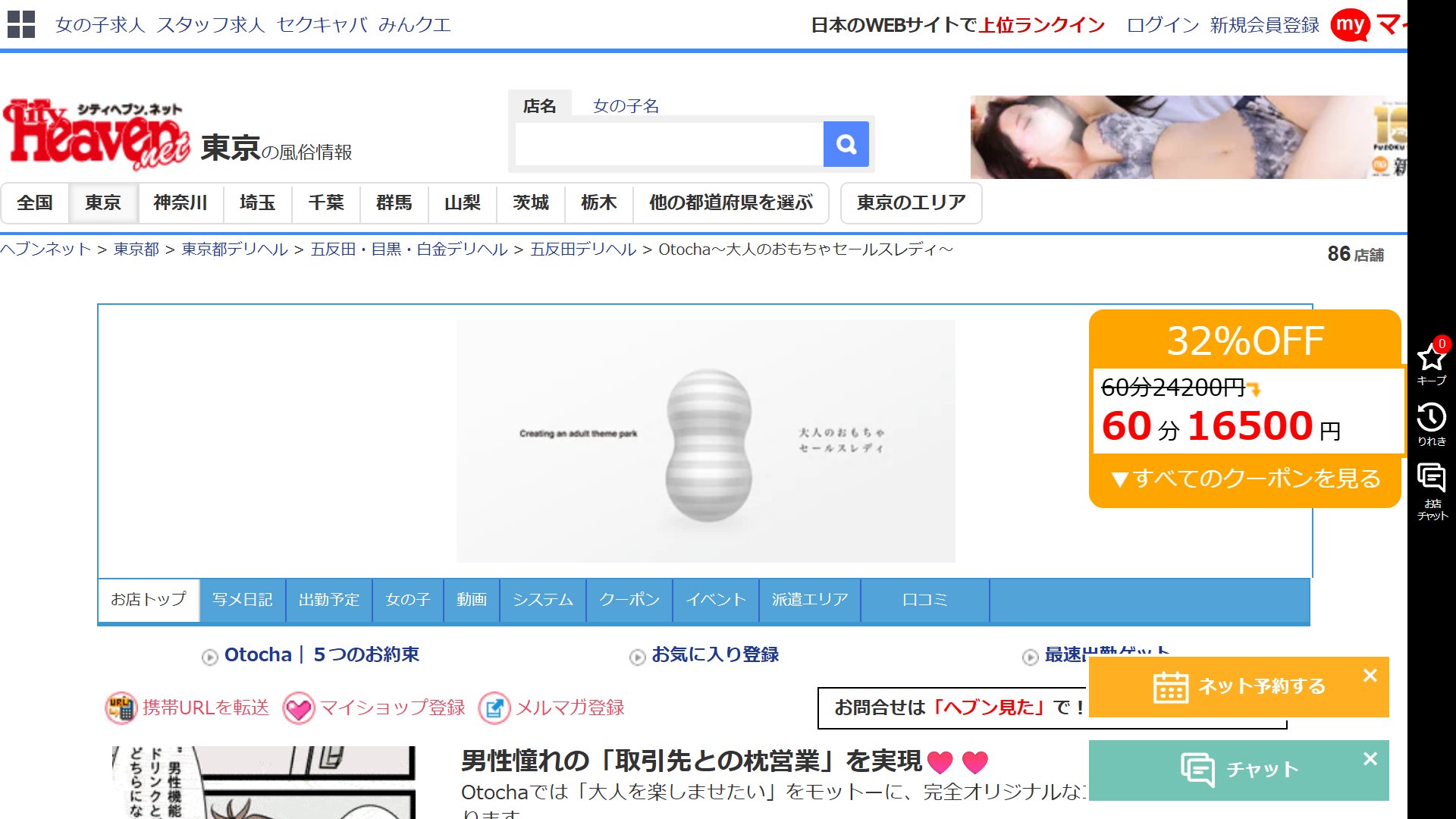
Most delivery-health shops sell you time and let you fill it. Otocha ~大人のおもちゃセールスレディ~ — roughly, "Otocha: the adult-toy sales lady" — sells you a premise, and the menu is organized accordingly. The courses aren't called courses. They're called attractions: the Pillow Sales attraction, the Reverse Pickup attraction, the Dating attraction, the Group attraction. You're not booking sixty minutes. You're booking a scenario, and the clock is just the container it ships in. The shop isn't being coy about it either — printed in English right across its main visual is the thesis statement: Creating an adult theme park.
The house concept is 枕営業 — makura eigyou, the old Japanese phrase for closing a deal in bed — layered onto a woman working the adult-toy trade in office wear. She's selling. You're the account. That's the fiction, and the shop runs on it from the name down. Based in Gotanda, Shinagawa Ward, doors from 8:00 in the morning to midnight, no regular holidays.
I came in curious about the gimmick and left more interested in the arithmetic, because this menu confesses things the copy doesn't.

What the Price Ladder Actually Confesses
Flat numbers, straight off the board. Entrance fee ¥2,200. The Pillow Sales attraction runs ¥19,800 / 60 min, ¥37,400 / 120 min, ¥55,000 / 180 min. Reverse Pickup runs ¥23,100 / 60 min and ¥40,700 / 120 min. Dating spans 30 to 240 minutes, ¥9,900 to ¥63,800. Group bookings for four or more run 120 to 300 minutes, ¥44,000 to ¥110,000. Extensions are ¥4,400 per 15 minutes, and nomination is ¥2,200.
Now do the subtraction, because this is where the shop tells on itself. Reverse Pickup costs ¥3,300 more than Pillow Sales at 60 minutes. At 120 minutes it costs — ¥3,300 more. Identical. The premium doesn't scale with time, which means it isn't paying for time. It's a setup charge. The shop is quietly telling you that the reverse-pickup scenario costs it something fixed and up-front — the staging, the approach, the woman having to run the whole opening as an actor rather than a host — and once that's paid for, the extra two hours cost no more than any other two hours.
The extension rate says the same thing from the other direction. ¥4,400 for 15 minutes works out to about ¥293 a minute, against roughly ¥330 a minute on the base 60. Extending is cheaper per minute than starting. That's not sloppy pricing; that's a shop that knows its expensive part is the front end — the dispatch, the setup, the character walking in the door — and is happy to sell you runway once the fiction is already standing up.
The Suit and the Pantyhose Went Free
Since the April renewal, two things moved from the paid-options column to the included column: suit-on service and pantyhose. They used to cost. Now they don't.
Read that as the shop settling an argument with itself. For an office-lady sales pitch, the suit and the hosiery are not accessories — they're the costume the entire premise hangs on. Charging for them meant the fiction had a surcharge; a guy could technically book the sales-lady attraction and have the sales lady show up out of uniform. Making them free is management admitting the wardrobe is the product, and that nickel-and-diming the one thing your shop is named after is a bad look. I'd call that a sign of a house paying attention. It's a small line item and it says more than the banner copy does.
The discount board is aggressive in the same direction: ¥7,700 off for new customers, ¥8,800 off during a staff member's debut period, ¥6,600 off for cast you haven't tried, and ¥3,300 off tied to posting a review. The page doesn't say these stack, so don't plan on it — assume the biggest one applies and treat anything more as a bonus you'll confirm at booking.
The Real Door Number
Do the honest total, because the headline never is one. Sixty minutes of Pillow Sales at ¥19,800 plus the ¥2,200 entrance is ¥22,000 before anything else. Designate someone and the ¥2,200 nomination makes it ¥24,200. Take the new-customer ¥7,700 off the top and you're at roughly ¥14,300, or ¥16,500 with a nomination — which is exactly the deal the shop leads with on its own front page, billed as 32% OFF: ¥24,200 → ¥16,500 for 60 minutes. Nice to find a headline coupon that survives being checked against the menu; plenty don't.
Then remember what genre this is. Otocha is delivery — she comes to you — and a delivery shop's price never includes the room. A Gotanda hotel is on your card, not theirs, and it lands on top of every number above. That's not a knock; it's how the format works everywhere. But it's the difference between "fourteen grand" in your head and what your wallet actually reports back, and the guys who get surprised are always the ones who did the first sum and skipped the second.
Who It's For
Not for the man who wants the fewest moving parts. Between an entrance fee, a scenario tier, a nomination, an extension rate, four different discounts and a hotel room you're sourcing yourself, this is a shop with a lot of surface area. If your ideal booking is one number and a door, the flat-rate store-based places will treat you better.
Not for the man who wants the toy as an accessory, either. Here it's the pretext, the script, the whole reason she's talking. That's a feature if you like being pitched and a bug if you wanted a quiet hour.
It's for the roleplay buyer who actually likes structure — who reads a menu of attractions and thinks good, I know what I'm ordering. The guy who'd rather pay a defined premium for a defined scenario than hope a generic booking drifts somewhere interesting. For him, Otocha's architecture is the appeal: pick the fiction, pay the staging cost, extend cheap once it's running, and take the morning slot when a suit in your doorway still reads as a sales call.
The toy theme is what gets Otocha noticed and it's the least interesting thing about it. What's actually going on is a shop that has decided to price scenarios instead of minutes, and then been unusually transparent about what each one costs to stage — a flat ¥3,300 for the reverse-pickup setup, extensions cheaper per minute than the opening hour, and a costume it stopped charging for once it admitted the costume was the point. That's a coherent little machine, and coherence is rarer in this trade than novelty. Go in having read the ladder, add the room to your math before you're standing in one, book the morning if you want the fiction to land, and Otocha gives you exactly the thing it advertises: not an hour, a premise — sold to you, appropriately enough, by someone whose whole character is that she's good at selling.
Summary
| Item | Rating |
|---|---|
| Scenario-based menu (clear, legible, you know what you ordered) | ★★★★☆ |
| Pricing honesty — flat ¥3,300 staging premium, cheap extensions | ★★★★☆ |
| Suit & pantyhose moved to free (costume treated as the product) | ★★★★☆ |
| Simplicity of the final bill (entrance + tier + nomination + hotel) | ★★☆☆☆ |
| 8:00–24:00 window, especially the morning slot in Gotanda | ★★★★☆ |
| Same shop if you wanted a toy as a quiet option, not a sales pitch | ★★☆☆☆ |