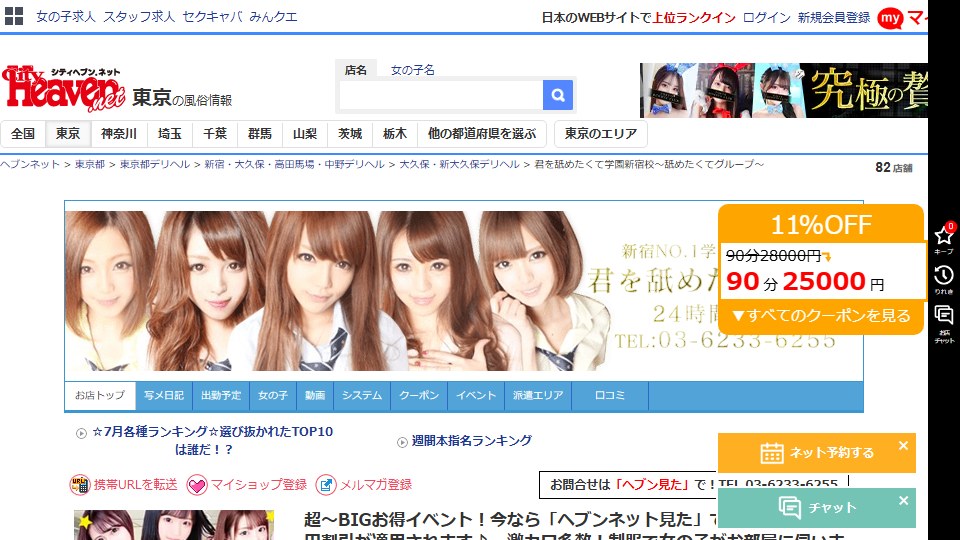

I booked a 75-minute basic out of Shin-Okubo, and I want to be straight about why: not the school-uniform framing, not the "forbidden extracurricular lesson" line in the concept copy, but the shape of the grid. Kimi wo Nametakute Gakuen Shinjuku-ko — 君を舐めたくて学園新宿校 — is a delivery health running out of Shin-Okubo in Shinjuku Ward, 10:00 in the morning to 5:00 the next, no days marked closed. Outcall, no shopfront, you go to the room and the shop comes to you. And its price table is one of the most legible I've read in Tokyo, because it accidentally publishes the operator's marginal cost.
The Meter Runs Cheapest for the First 75 Minutes
Here's the basic course, straight off the sheet: 60 minutes ¥16,000, 75 minutes ¥20,000, 90 minutes ¥25,000, 120 minutes ¥35,000, 180 minutes ¥55,000, 240 minutes ¥75,000. Now do the thing nobody does and price the gaps instead of the rows.
Sixty to seventy-five is ¥4,000 for fifteen minutes — about ¥267 a minute, the exact same rate as the 60 itself. Then it changes and never changes again. Seventy-five to ninety is ¥5,000 for fifteen. Ninety to one-twenty is ¥10,000 for thirty. One-twenty to one-eighty is ¥20,000 for sixty. One-eighty to two-forty is another ¥20,000 for another sixty. That's ¥333 a minute, flat, for every single minute past the 75-minute mark, held dead level across three hours of menu.
Which inverts what you expect. Almost every service business discounts volume — book longer, pay less per unit. This shop does the opposite: the first 75 minutes are the cheap part at ¥267, and everything after is a flat, un-discounted ¥333. The blended rate therefore climbs the longer you stay, from ¥267 a minute at 60 up to ¥313 at 240. There's no bulk deal here. There's an on-ramp, and then a meter.
The Upgrades Are Door Fees, Not Rates
Four course tiers sit on top of each other, and this is where the grid gets genuinely interesting. The basic is the floor. The second tier runs ¥2,000 more. The third runs ¥3,000 more. The top one, billed as a special AV-actor course, runs ¥10,000 more.
More than what duration, though? That's the point: more than all of them. The surcharge is identical at 60 minutes and at 240 minutes. ¥16,000 becomes ¥26,000 at the top tier; ¥75,000 becomes ¥85,000. Same ten grand either way.
So the upgrade isn't priced as a service level — it's priced as admission. And that has a consequence the menu doesn't spell out: the premium tiers get proportionally cheaper the longer you book. Ten thousand yen on top of a ¥16,000 hour is a 63% markup. The same ten thousand on a ¥75,000 four-hour block is 13%. If you were ever going to take the top tier, taking it on a short course is the single most expensive way to do it. The table is quietly steering the upgrade-minded customer toward long bookings, and it's doing it without a word of sales copy.
The ¥12,000 Extension Is a Tax on Indecision
Thirty-minute extension: ¥12,000. Run it against the meter you already know. Booked up front, thirty minutes past the 75 costs ¥10,000. Decided on the spot, in the room, it costs ¥12,000. That's ¥400 a minute against ¥333 — a flat 20% penalty for making the call late.
I don't read that as gouging. Late demand is genuinely more expensive to serve: it wrecks the next dispatch slot, it puts the schedule on the back foot, and the shop is buying the option back off its own timetable. But it's a real number and it points one direction — decide before you book, not after. The pricing punishes hesitation by exactly a fifth, every time.
Loyalty Costs More Than Curiosity
This one made me sit up. Photo designation is ¥2,000. Repeat designation is ¥3,000. Picking someone off a picture is cheaper than asking for the person you already know.
Most industries invert that — the returning customer is the cheap one to serve and gets rewarded for it. Here, going back to a specific person costs 50% more than picking a new face. Which tells you the fee isn't a loyalty program at all; it's a scarcity price. A named request constrains the schedule to one calendar instead of a roster, and the shop charges for the constraint. It also, if the money moves the way it usually does, gives the requested person a direct stake in being requested again. That's not a customer-retention discount. That's a supply-side incentive dressed as a booking fee — and honestly, it's the more rational design of the two.
The Rest of the Machine
Transport runs ¥1,000 to ¥4,000 depending on where you are. Variable, disclosed, tiered by distance — no pretending the last mile is free and no burying it in the course price. I'll take a stated travel charge over a padded base every day of the week. There's a free options tray (eye mask, cuffs, glasses, loose socks) and a paid one running ¥1,000 to ¥7,000, plus an outlier group product — a six-hour course at ¥200,000 per person for parties of two to five. Price that per minute and it lands around ¥555, roughly 67% over the solo marginal rate. Group logistics cost what group logistics cost.
And behind the one Shinjuku branch is the group: a roster listed on the order of 9,591 across affiliated locations. That's platform scale — one recruiting funnel, one dispatch standard, one system amortized across a lot of doors. It's the reason a single Shin-Okubo branch can hold 10-to-5 hours and still field depth.
The Verdict on the Machine
- Table legibility: ★★★★★ — six durations, four tiers, every surcharge and fee printed. You can compute the whole cost model before you dial.
- Rate structure: ★★★☆☆ — flat ¥333/min past 75 minutes is honest but un-generous. No volume discount exists here; don't go looking for one.
- Best cell on the sheet: the 75-minute basic at ¥20,000 — the last block priced at the ¥267 on-ramp rate before the meter steps up.
- Extension pricing: ★★★☆☆ — ¥12,000 for thirty is a clean 20% late-decision premium. Defensible, but decide up front.
- Designation logic: ★★★★☆ — repeat over photo is counterintuitive and, on reflection, correctly aimed at the supply side.
- Going back: ○ — as a legible, no-surprises outcall out of Shin-Okubo where the arithmetic is settled before anyone moves, yes. Long and upgraded, or short and basic — the middle of this grid is the worst value on it.
I came for the spreadsheet and the spreadsheet held up. The concept copy is school-themed theater and I have nothing to say about it. What I'll actually remember about Kimi wo Nametakute Gakuen Shinjuku-ko is a price table that tells the truth by accident: a subsidized first 75 minutes, a flat meter after, upgrades sold as admission rather than rate, and a fifth-again penalty for changing your mind in the room. Read left to right, it's a business that knows exactly what an hour of its supply costs and has stopped pretending otherwise. Shin-Okubo run logged, and the math closed.