A Working Town Gets a Working Man's Shop
Kamata doesn't put on airs, and neither does the place I'm about to walk you through. This is Ota Ward — the flatlands south of the glamour, where the trains run out to Haneda, where the izakaya are lit by beer-poster fluorescents and the guy next to you at the counter has motor oil under his nails and no interest in impressing anyone. It's one of the most honest neighborhoods in Tokyo. And One More Okusama Kamata is one of the most honest kinds of shop: a mature-women delivery health — deriheru — that opens the menu at ¥11,000 for sixty minutes and doesn't waste your evening pretending to be a boutique.
Let me set the frame, because the word "okusama" trips up every visitor. It means "wife" — the shorthand for the hitozuma / mature-woman genre, women generally past the idol-cosplay bracket, cast for exactly that. This isn't a shop selling you twenty-two-year-olds in schoolgirl skirts. It's selling the specific appeal of the older woman: composure, warmth, a lack of nerves. If that's not your thing, One More isn't for you and it will never once apologize for it. If it is, keep reading, because the town and the shop are the same personality.

Reading the Price Ladder
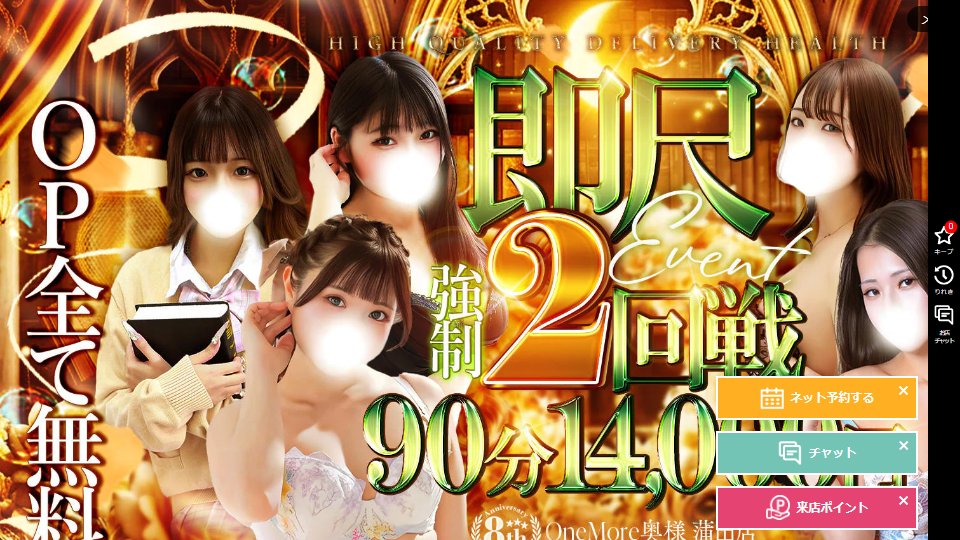
Here's the ladder exactly as it stands: 60 minutes ¥11,000, 75 minutes ¥13,200, 90 minutes ¥16,500, 120 minutes ¥22,000. And the number that matters most for a newcomer is the one off to the side — 90 minutes for ¥14,000, first-timers only. Do the arithmetic the shop is quietly doing for you: the standard ninety is ¥16,500, so the trial knocks ¥2,500 off and lands you at a price barely above the sixty-minute rate. That is not a rounding gift. That is the shop betting real money that if it can get you into the ninety-minute course once, you'll never go back to the hour.
And they're right to bet it, because sixty minutes is the wrong course for outcall and everyone keeps buying it anyway. An hour has to absorb the arrival, the small talk, the shower, the settling-in — all the overhead — before the good part even starts, and in the okusama genre the settling-in is half the appeal. Ninety minutes is where the composure this genre sells has room to actually breathe. The first-timer discount isn't the shop being generous; it's the shop being smart about which course makes you come back. Take it. It's the single best-value number on the page and it only exists once.
The System Copy Is Loud. Read It Like a Menu, Not a Promise.
One More's page leans hard into an aggressive instant-play system — the copy advertises immediate service on arrival and a "forced second round," with a couple of extra acts (the ones the genre abbreviates) thrown in free on the 90-minutes-and-up courses. This is standard high-intensity deriheru marketing, and here's the sober way to read it: it's a description of the shop's format, not a personality test for the woman who shows up. The system tells you the tempo the house is built around — fast, no long warm-up, value-dense. It does not tell you to skip being a human being when she walks in.
That distinction is the whole game. A shop that sells an aggressive tempo is optimizing for the customer who knows what he wants and doesn't need forty minutes of coaxing — which, in a workingman's town at the end of a shift, is most of the clientele. Fine. But "fast system" and "considerate customer" aren't opposites; the guys who get the best version of an intense-tempo shop are the ones who are still warm, still clean, still easy to be around. The system is the shop's efficiency. Your manners are still yours. Bring both and this format is genuinely good value. Bring only the first and you've bought a stopwatch.
So — Who's It For?
One More Okusama Kamata is for the man who wants the mature-woman experience without the boutique tax — someone booking a Kamata hotel, calling in the honest hours (the reception runs 9:30 in the morning to 5 the next morning, no day off), and smart enough to take the ninety-minute trial the first time instead of the hour. The near-round-the-clock window makes it a live option for Haneda travelers landing at ugly times and locals coming off a late shift, and the fee structure — no designation charge, free shower, free local transport — means the entry price is close to the real price if you keep the room inside the neighborhood.
Worth it? On the promise it actually makes — a straight-shooting okusama deriheru with aggressive value and a system built for men who know what they want — yes, provided you book in Kamata, take the trial course, and confirm the all-in on the phone. On any promise it doesn't make — a young roster, a storefront experience, a leisurely boutique pace — no, and the shop never once pretends otherwise. That's the thing about Kamata. Nobody's selling you a fantasy version of the place. One More fits its town exactly: unpretentious, priced for a working wallet, and completely uninterested in being anything other than what it is. Bring a decent local room and a bit of manners, and it'll bring the rest.
Most of this industry hopes you don't notice how ordinary the room behind the marketing really is. A blue-collar okusama shop in Ota Ward does the opposite — it never dressed the room up in the first place. That's a kind of honesty worth pricing in, and it's exactly the kind Kamata rewards.
Summary
| Item | Rating |
|---|---|
| Value at the ¥11,000 / ¥14,000 entry | ★★★★★ |
| First-timer 90-min trial | ★★★★★ |
| Fee transparency (no shimei, free local transport) | ★★★★☆ |
| Hours & availability (9:30am–5am, no day off) | ★★★★★ |
| Fit for the okusama / mature-woman genre | ★★★★☆ |