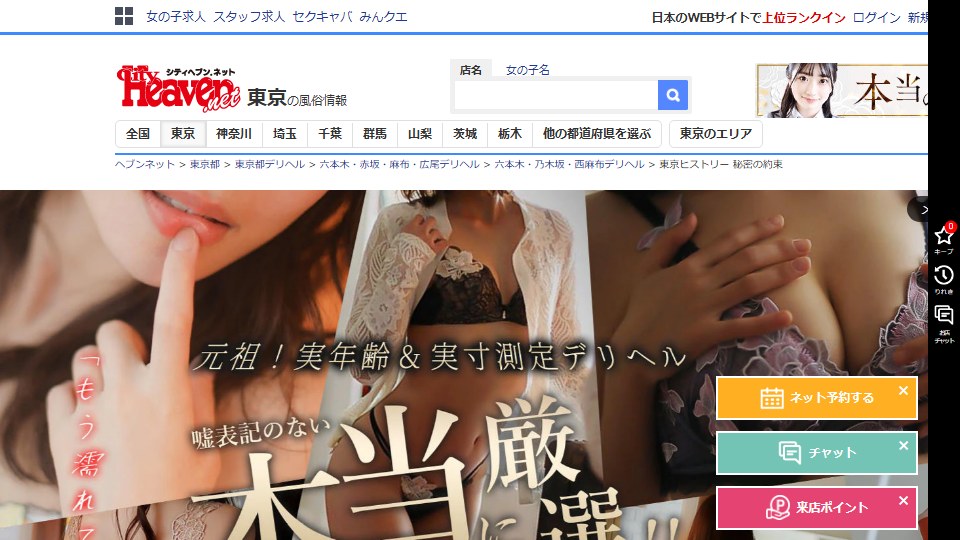

Roppongi is the part of Tokyo that foreigners think is all of Tokyo and that Tokyoites mostly avoid. Embassies on the hills, the Mori Tower and its art museum floating above Roppongi Hills, Tokyo Midtown across the way, and underneath all that glass a crossing where touts have been working the same forty meters of pavement since the Occupation. Nishi-Azabu, one hill over, is where the money goes when it wants to stop being seen. Nogizaka is where it lives.
It's an odd catchment for a delivery shop. There's no soap street, no wall of pink neon, no arcade of storefronts — the whole ward is hotels, apartments, and embassies. Which means an outcall operation here isn't competing on frontage. It's competing on what it says about itself. 東京ヒストリー 秘密の約束 — Tokyo History Himitsu no Yakusoku, "the secret promise" — has decided what it says about itself is: our numbers are true.
The shop
A deriheru (delivery health, outcall) filed on Cityheaven under 六本木・乃木坂・西麻布, classified 高級 — the premium tier. Address given as 東京都六本木(港区). Phone 03-6277-4583. Official site h-yakusoku.com. Hours 9:00–25:00, reception 9:00–23:30, 定休日:無し — no closed days.
Dispatch is unusually broad: ラブホテル、ラグジュアリーホテル、ビジネスホテル、ご自宅、Airbnb(エアビーアンドビー). Love hotels, luxury hotels, business hotels, your apartment, and — named explicitly, which I have not seen printed on a Japanese shop page before — Airbnb. Service range is 山手線主要駅や都内近郊, the Yamanote's major stations and the near suburbs.
It's one shop in a group. The breadcrumb counts 34 stores and 3,120 women across the operator's whole listing — that's the group, not this branch, and anyone quoting it as a Roppongi number is doing you a disservice. The sister brands are named on the site: 私の愛人事情, 東京ヒストリー lettre d'amour, モンラッシェ東京, and six 百合の園 outlets. The operating company is published too — 株式会社マウルール, with a Mitsubishi UFJ account at the Gotanda branch. A Roppongi shop banking in Gotanda tells you roughly where the group actually lives.
The claim
Here's the pitch, in the shop's own words:
年齢やスリーサイズを調整したり盛ったりするのが当然の業界風習に風穴を開けるべく、自己申告やお店の忖度を除外して年齢は「免許証」や「パスポート」等で確認。
Adjusting and inflating ages and measurements is the industry's normal practice; we're putting a hole in that wall. Age is confirmed against a driver's license or passport — not self-reported, not massaged by the shop. And then the part they call an industry first:
"業界初!採寸用メジャーでのスリーサイズ実寸計測"
Three sizes measured objectively with a tailor's tape.
There's a follow-on detail that I like more than the claim itself: 実年齢は…生年月日から年齢を自動的に算出して表示しており、毎年1月1日に実年齢がひとつ上がります。 Ages are computed from date of birth and everyone on the roster gets a year older on January 1st. Not on her birthday — on New Year's Day, all at once, by policy. On 2027年1月1日 this entire roster ages twelve months overnight. A shop willing to eat that is at least serious about the mechanism.
So I checked it
Claims about honesty are cheap. Distributions are not. I pulled every entry off the roster page and ended up with eighty distinct measurement rows — age, height, bust, cup, waist, hip. Then I looked at the shape.
| Field | Range | Mean | Median |
|---|---|---|---|
| Age | 30 – 45 | 39.5 | 39 |
| Height | 150 – 171 cm | 159.4 cm | 160 cm |
| Waist | 57 – 74 cm | 62.2 cm | 62 cm |
The height mean is the first tell. 159.4 cm sits within a hair of the actual average height of adult Japanese women. Fabricated boards drift upward, because taller reads as more glamorous and costs nothing to type.
The waist column is the real evidence. Here is the full distribution across eighty women:
| Waist (cm) | 57 | 58 | 59 | 60 | 61 | 62 | 63 | 64 | 65 | 66 | 67 | 68 | 69 | 70 | 74 |
|---|---|---|---|---|---|---|---|---|---|---|---|---|---|---|---|
| Count | 2 | 7 | 13 | 10 | 8 | 5 | 7 | 7 | 7 | 6 | 4 | 1 | 1 | 1 | 1 |
Fifteen distinct values. A long, lumpy right tail. Twenty-one of eighty women — better than one in four — are listed at 65 cm or above, and somebody on this roster is published at 74.
That last number is the whole argument. No shop inventing figures types a 74 cm waist onto a premium board. Invented boards cluster at 56–58 and stop, because the person typing them is optimizing, and optimizers don't produce tails. Tails come from measuring.
The cup distribution says the same thing from the other direction: C is the single most common cup on the roster, 28 of 80, with D at 21. Together that's 61% of the women in the two most ordinary sizes on the scale, against three H's, two G's and a single I. Marketed boards are F-heavy for exactly the reason you'd guess. This one is C-heavy, which is what a room full of women in their late thirties actually looks like.
The age column has no one under 30 and no one over 45, clustered hard at 37–43 — twelve women aged 39, nine aged 43, nine aged 37. The shop's own copy is blunt about the positioning: 若過ぎず、熟女でもない…そんな『ちょうど良い』年齢 — not too young, not jukujo either, the "just right" age.
The board
Now the part that doesn't come off as well.
| Course | Price | Per minute |
|---|---|---|
| 100 min | ¥40,000 | ¥400.00 |
| 150 min | ¥50,000 | ¥333.33 |
| 200 min | ¥60,000 | ¥300.00 |
| 250 min | ¥70,000 | ¥280.00 |
| 300 min | ¥80,000 | ¥266.67 |
| 350 min | ¥95,000 | ¥271.43 |
| 400 min | ¥110,000 | ¥275.00 |
| 500 min | ¥140,000 | ¥280.00 |
| 600 min | ¥170,000 | ¥283.33 |
| 800 min | ¥230,000 | ¥287.50 |
| 1000 min | ¥290,000 | ¥290.00 |
Nineteen rungs in total, in 50-minute steps from 100 minutes to 1000. Extension: 50 minutes ¥15,000, or 100 minutes ¥30,000 — the same rate, so the bulk extension isn't a bulk anything.
Read the per-minute column top to bottom. It falls, bottoms out at 300 minutes, and then climbs again for the next fourteen rungs. That is not a volume discount with a dent in it. That is a volume discount that inverts. The 1000-minute course — sixteen hours and forty minutes, ¥290,000 — costs more per minute than the 250-minute course. You can buy four times as much time and get a worse rate for doing it.
One hinge, and it's at 300
Difference the rungs and the whole board collapses into two rules.
| Range | Cost per extra 50 min | Per minute |
|---|---|---|
| 100 → 300 | ¥10,000 | ¥200.00 |
| 300 → 1000 | ¥15,000 | ¥300.00 |
| (extension) | ¥15,000 | ¥300.00 |
Below 300 minutes, every additional 50 minutes costs ¥10,000. At 300 and above, every additional 50 minutes costs ¥15,000 — which is exactly, to the yen, the price of an extension.
Follow that through. Book the 300 at ¥80,000 and extend fourteen times at ¥15,000 and you have paid ¥290,000 for 1000 minutes. The 1000-minute course costs ¥290,000. Not approximately. Identically. And the same holds at every rung in between.
Fourteen of the nineteen courses on this board are arithmetically indistinguishable from booking the 300 and extending. They commit you in advance to a decision you could make later, at the same price, in the room. The only thing you buy by booking them is the loss of the option not to.
So on a nineteen-rung board there are exactly two rungs doing work: the 150 and the 300. Everything below 150 is expensive, everything above 300 is decorative, and the space between them is one clean ¥200-a-minute ramp.
Which makes the header banner worth a second look. The shop's Cityheaven headline is お泊りコース好評😍 — the overnight course is popular. Every overnight-length course on this board is priced at precisely the extension rate. The thing they advertise hardest is the thing with the least discount in it.
The 150 is the one, and here's why it isn't close
The fees are where this gets interesting, because they don't apply uniformly:
- 入会金 ¥3,000 — one-time membership. Waived if you're already a member of sister shops 私の愛人事情 or レトルダムール.
- 指名料 — 本指名 ¥2,000, WEB指名 ¥1,000, お任せ free.
- 交通費 — free in 品川・港・中央・目黒・渋谷・新宿・千代田・豊島; ¥3,000 in 大田・世田谷・江東・文京・台東・墨田・杉並; ¥4,000 everywhere else.
And then this line, which is the second most important sentence on the page:
150分コース以上は、入会金、交通費(無料エリア外もあり)、指名料(web指名料、本指名料)は無料
At 150 minutes and up, membership, transport and nomination all go to zero. Run the comparison for a first-time customer naming a specific woman, in Setagaya:
| 100 min | 150 min | |
|---|---|---|
| Course | ¥40,000 | ¥50,000 |
| Membership | ¥3,000 | — |
| 本指名 | ¥2,000 | — |
| Transport (¥3,000 zone) | ¥3,000 | — |
| All-in | ¥48,000 | ¥50,000 |
| Per minute | ¥480.00 | ¥333.33 |
Two thousand yen buys fifty more minutes. Forty yen a minute, against a marginal rate of ¥200 everywhere else on the board and ¥300 in the room. There is no configuration where the 100 wins. Even in the best case for it — repeat customer, お任せ, free-transport ward — the step from 100 to 150 costs ¥10,000 for fifty minutes, which is ¥200 a minute, still a third cheaper than extending.
And the ¥50,000 landing spot has a small bonus attached, which we'll get to.
The coupons, and the one that looks cheapest
Three are posted, and they do not rank the way they look.
☆ヘブンWeb予約限定!80分コース☆ — 80 minutes, ¥30,000, all-time, transport free. Web reservation only. On raw course rate that's ¥375 a minute, genuinely better than the 100's ¥400. But membership and nomination still apply, so a first-timer using it pays ¥30,000 + ¥3,000 + ¥1,000 = ¥34,000 for 80 minutes, or ¥425 a minute — the most expensive minute available anywhere in this shop. The cheapest number on the page produces the worst rate on the page. That's not a trick; it's just what happens when fixed fees land on a short course.
☆150分以上のご利用で交通費と指名料が割引☆ — the listing shows ¥55,000 → ¥50,000, waiving a ¥1,000 nomination and a ¥4,000 transport charge. Note the ¥4,000: the system page only promises the ¥3,000 zone goes free at 150+, with 詳しくはお問い合わせくださいませ on the rest. This coupon appears to extend it to the outer ring. Worth one phone question.
☆ご新規様限定割☆ — 100 minutes, membership waived, ¥43,000 → ¥40,000. Real money, wrong course. A first-timer who takes this instead of booking the 150 saves ¥3,000 and gives up fifty minutes that the 150 would have handed over for ¥2,000.
Cityheaven stamps percentage badges on all three. The badges and the arithmetic underneath them are not the same quantity, and the arithmetic is the one to read.
The rotor date, priced honestly
There's a new offering posted this week — 『リモコンローターin羞恥デート♡』, the remote-rotor date. A woman arrives at the meeting point already wearing it and hands you the remote.
| Course | Event price | Base price | Difference |
|---|---|---|---|
| 100 min | ¥42,000 | ¥40,000 | ¥2,000 |
| 150 min | ¥52,000 | ¥50,000 | ¥2,000 |
| 200 min | ¥62,000 | ¥60,000 | ¥2,000 |
A flat ¥2,000 — which is exactly the published price of paid option ④, ピンクローター(iroha stick). The "new project" is the standard option under a better name, and it costs what the option costs. No markup for the framing. I'll take that over a shop that charges ¥8,000 for a concept.
There is a real rule attached — 移動範囲はお待ち合わせ場所から2駅まで, two stations' travel from the meeting point — and the shop suggests cafés and shopping on the 100, an aquarium or a meal on the 150, a cinema on the 200. Which brings up the expensive part, and it isn't the rotor.
The clock is the product
お会いした時点で時間スタートになり
Time starts the moment you meet. Not at the hotel door. The shop is candid about it and builds romance around it: meet at a station, have dinner, wander, then go upstairs.
Do the arithmetic on that romance. On the 100-minute course at ¥400 a minute, a thirty-minute coffee costs ¥12,000 of what you paid for. On the 150 it's ¥10,000. If you extend to cover it, you're buying that coffee at ¥300 a minute, or ¥9,000 for the half hour.
None of which makes the date framing dishonest — it's disclosed in plain language, twice. It just means the aquarium is not free, and the number attached to it is bigger than most people will estimate standing on the platform. If you want dinner and a room, book the 200 and stop pretending the clock isn't running.
The things nobody else prints
A few items on this system page I have not seen elsewhere, and which are worth more than most of the marketing.
A refund guarantee with teeth. 万が一掲載とは違う女性のご案内があった場合、キャンセルしていただいて構いません…すでにカード決済等でお支払いがお済みの場合、全額返金をお約束いたします — if the woman who arrives isn't the one advertised, cancel at no charge, full refund even if you've already paid by card. And 明らかに接客内容で失礼があった場合も全額返金の対象 — clearly rude service, same remedy. A shop that sells accuracy and then puts a money-back promise behind the accuracy is doing the one thing that makes the claim cost something. (Changing your mind after meeting, because she isn't your type, is ¥3,000. Fair.)
Discretion engineered rather than promised. Card charges appear as STAR-PAY, STP or SP — never the shop name — and card details never reach the shop. Payment runs four ways: card, bank transfer, cash, PayPay.
The trash goes home with her. お伺いして発生したゴミは『もしかしたらご家族に迷惑をかけるかも…』という発想を元に女性が持ち帰ります. Rubbish generated during a home visit leaves with the woman, on the reasoning that it might otherwise cause trouble with your family. That is a genuinely thoughtful operational detail and it costs the shop actual effort.
Receipts, with tax commentary. Handwritten duplicate receipts issued same-day with a day's notice, revenue stamps handled on amounts of ¥50,000 and over, PDF e-receipts on request. And then the shop volunteers the part its customers actually get wrong: 風俗の領収証であっても、接待交際費で処理してあり…損金算入できます — deductible as entertainment expense if properly booked, but ご自分で風俗を利用した領収証ならご自分の会社の経費にはできません, your own visit is not your company's expense. I have never seen a shop print correct tax guidance against its own interest. Note also where the stamp threshold sits: ¥50,000 is exactly the 150-minute course. The rung I'd tell you to book is the first one that comes with a revenue stamp on it.
Compliance stated plainly. 当店では本番行為等、一切を禁じております, and 「新風俗営業適正化法:第31条」に基づく営業届出済み店. No 本番. Filing on record. The prohibited list runs the usual way with one sharp edge: filming or recording gets 顧問弁護士に依頼し警察署へ被害届を即日提出 — lawyer, police report, same day.
What's included
Base service: ディープキス、生フェラ、69、指入れ、素股、アナル舐め、脱衣アシスト、ボディ洗い、ランジェリープレイ、口内発射 — with the honest caveat 女性により可能なプレイ内容に差異がございます, it varies by woman, check her page.
Paid options run ①–⑩ at ¥2,000 each — ノーパン, バイブ&電マ (iroha RIN+), ガーターベルト, ピンクローター (iroha stick), 私物コスプレ, 前立腺マッサージ, パンスト破り, 全身網タイツ, SVR, TENGA UNI — and ⑪ウーマナイザー at ¥3,000. One line matters more than the list: 有料オプション…は女性の手取り(全額報酬)となります. Every yen of option money goes to the woman. That makes the option menu a tipping mechanism with a printed price list, which is a better system than tipping, because both sides know the number in advance.
What the page doesn't tell you
Whether the ¥4,000 transport ring is really free at 150+. The system page promises the ¥3,000 ring and hedges the rest; the coupon shows ¥4,000 waived. One question, ¥4,000 at stake.
Why Nakano costs ¥4,000 and Suginami ¥3,000. Nakano is closer to Roppongi than Suginami is, and sits in the more expensive ring. The transport board is not strictly a distance function, and nothing explains the shape.
Nothing about health screening. I could not find a testing or hygiene statement on either the listing or the official system page. Plenty of shops publish a screening cadence. This one, which publishes more verifiable detail than almost anyone, doesn't publish that.
The 300-minute hinge, obviously. It is the single most useful fact on the board and it exists nowhere in words — only in the differences between the numbers.
What it costs, all in
First visit, a Minato-ward hotel, 150 minutes, one named woman, no options: ¥50,000. Membership waived by the course, nomination waived by the course, transport free by the ward. Nothing added at the door. For a shop filed under 高級 in Roppongi, that's a legible number, and legibility is most of what I'm buying.
Same visit in Setagaya: still ¥50,000. In Nerima: ¥50,000 or ¥54,000 depending on the answer to the transport question. Add the rotor and it's ¥52,000. Want dinner first: budget the clock, not the menu.
The number I'd actually pay: ¥80,000 for the 300, one option, meeting at the hotel rather than the station so the five hours are five hours. It's the cheapest minute this shop sells and the last rung before the board stops rewarding you for buying more.
Verdict
- Honesty of the roster data: ★★★★★ — the claim is specific, falsifiable, and it survives the check. Eighty rows, a 15-value waist spread with a 74 in the tail, a C-heavy cup distribution and a height mean on the national average. That is what measured data looks like.
- The 150: ★★★★★ — the fee waiver makes fifty extra minutes cost ¥2,000 for a first-timer. Nothing else on the board is in this neighborhood.
- The 300: ★★★★☆ — the per-minute floor, and the last honest rung.
- Courses above 300: ★☆☆☆☆ — fourteen rungs priced at exactly the extension rate. Book the 300 and decide in the room; the arithmetic is identical and the option is free.
- The 80-minute web special: ★★☆☆☆ — the cheapest headline and the worst rate once the fixed fees land. Fine for a repeat member in the free zone, poor for the first-timer it's aimed at.
- Disclosure and paperwork: ★★★★★ — published refund guarantee, published operating company, card-descriptor detail, four payment rails, and tax advice that argues against the shop's own upsell. Marked down nowhere except the missing health statement.
- Going back: ○ — the 300, afternoon, hotel meet.
What stays with me is the asymmetry. This is a shop that took the industry's most routine lie — the ages and the three sizes — and dismantled it in public, with a tape measure and a passport check and a refund promise behind it, at real cost and for no reason except that it decided to. And then it built a price board with fourteen decorative rungs on top, where the per-minute rate quietly climbs the more you buy, and never mentions the one number that would let you see it.
Neither of those is deception, exactly. The board is fully published; every figure I used to take it apart was sitting there in plain sight. But it does tell you where the shop spends its honesty. It spends it on the women, which is the harder place to spend it and the place customers can't verify. What's left over goes on the arithmetic, which anyone can verify and almost nobody does. Given the choice between a shop that lies about the roster and tells the truth about the prices and one that does it the other way around, I know which I'd rather meet at a hotel in Nishi-Azabu. Just bring a calculator, and book the 150.