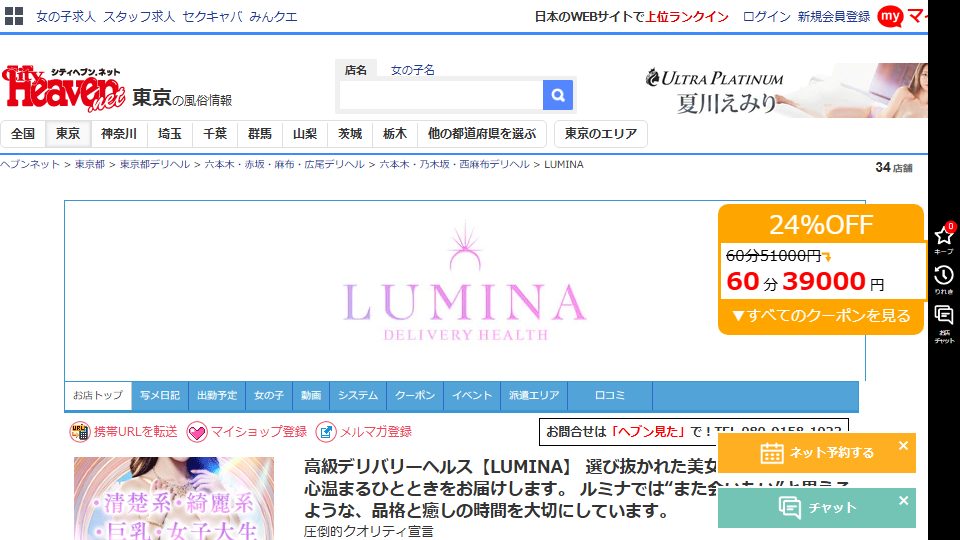

Let me tell you exactly what LUMINA — ルミナ — is, because the word "high-class" gets thrown around until it means nothing, and this shop is worth being precise about. It's a デリヘル, a delivery health, a deriheru — no storefront, no lobby, you phone in or book online and she comes to your hotel or residence — working the Roppongi / Nishi-Azabu / Nogizaka triangle in Minato Ward, which is to say the single most expensive square mile of nightlife real estate in Tokyo. And it casts at the top of the market: gravure models, AV actresses, idols — the kind of roster most shops namedrop and this address can actually staff. The concept word is iyashi — healing, quality-and-comfort — and the pitch, stated plainly on the page, is the "fail-proof encounter." That phrase is the entire business. I went to Roppongi to figure out what it costs to never miss.
The Price Ladder Is a Confidence Meter, Not a Menu
Look at the numbers as a structure, not a list. Luminous class opens at ¥35,000 for 60 minutes and runs to ¥63,000 for 120. Above it: Radiant at ¥45,000–¥75,000, Eternal at ¥60,000–¥100,000, Diamond at ¥80,000–¥120,000, and Legend by inquiry only — the "if you have to ask" tier. Five rungs. Most men read that and see "how pretty" going up the ladder. That's the wrong axis. What actually climbs each rung is scarcity and profile — the Legend tier isn't ten times prettier than Luminous, it's ten times harder to book, because it's the working gravure model with a name you'd recognize and a calendar that opens for six hours a month. You're not buying beauty by the yen. You're buying access to someone whose day job makes her expensive to pull into a hotel room at all. The ¥120,000 isn't a markup on skin. It's the opportunity cost of a woman who has other, well-paid places to be.
The "Fail-Proof Encounter" Is a Consultation Service Wearing a Deriheru's Clothes
Here's the part that separates LUMINA from a shop that just charges a lot. The headline promise isn't a girl — it's a process: careful casting plus a customer consultation that matches you to the right woman before you commit. Sit with that. What they're actually selling at ¥35,000-and-up is the elimination of your own bad judgment. The failure mode at every price point is the same — you pick off a photo, you build a fantasy, the fantasy and the person don't line up, and the hour dies in the gap between them. A cheap shop shrugs at that gap; it's baked into the ticket price. LUMINA's whole proposition is that the gap is the product they've decided to kill — by asking what you actually want and steering you off the mismatch before it happens. The consultation isn't customer service. It's the core good. You're paying a premium for a shop that takes responsibility for the match instead of leaving it entirely to your thumb on a photo grid.
Costumes, Fees, and the Late Clock
The operational details tell you who the shop is built for. Fifty-plus fetish costumes, free with an online booking (¥1,000 otherwise) — a small tell that the target customer is here for a produced experience, not a rushed transaction; you don't stock fifty outfits for men in a hurry. No registration fee, which at this tier is table stakes, not generosity. Transport runs ¥3,000 to ¥6,000-plus depending on how far she's traveling — real money, and a reminder that "delivery" to a Nishi-Azabu hotel is cheap while delivery to your place across town is not; book your room close to the shop's center of gravity and the math improves. And the door is open 12:00 PM to 6:00 AM, reception until 4:30 AM, seven days a week — an eighteen-hour clock that owns the Roppongi after-hours crowd, the men still out when the last train left and the cheaper shops shut. At this price the 3 AM booking isn't desperation; it's a man who can afford to not care what time it is.
The Roster Caveat, Sharpened
The standard warning applies with extra teeth here. A high-profile roster is deep on paper and thin on any given night, because the whole point of the Legend and Diamond tiers is that those women work rarely. "LUMINA casts idols and gravure models" is a true statement about the brand and a nearly useless one about your Tuesday. Book the shop for the floor it guarantees; nominate the specific woman, in her specific window, for the ceiling you actually want — and use the consultation for exactly that, because a shop selling a matching service should be able to tell you honestly who's real and available versus who's a photo on the wall this month. If they can't or won't, the "fail-proof" promise is just copy. If they can, you've found the rare shop that earns its floor price.
The Verdict at the Top of the Market
- Concept clarity: ★★★★☆ — "healing, fail-proof encounter" is a genuine, coherent product — the shop is selling the death of the mismatch, not just adjectives, and it knows it.
- Casting credibility: ★★★★☆ — the gravure/AV/idol claim is the one most shops fake, and the Roppongi–Nishi-Azabu address is what makes LUMINA's version structurally believable rather than aspirational.
- Price honesty: ★★★★☆ — a legible five-tier ladder from ¥35,000 to ¥120,000-plus that prices scarcity, not fantasy; expensive, but the number tells the truth about what climbs it.
- Access / hours: ★★★★☆ — an eighteen-hour clock into the small hours suits the neighborhood, though transport math rewards booking a room near the shop's core, not across the city.
- Going back: ○ — for the man who's done gambling on cheap misses and wants the match handled, the consultation-plus-floor model makes the return an easy call; for the man chasing a one-off wildcard, this isn't the table.
I went to Roppongi to price out "never missing," and the honest read on LUMINA is that it's built for a specific customer: the man who has stopped enjoying the lottery. At ¥35,000 the floor, you are not buying a prettier woman than the ¥12,000 shop offers — you're buying a company that has staked its model on the encounter not going sideways, and put a consultation between your fantasy and the booking to make sure it doesn't. The gravure-and-idol casting is real because the address makes it possible to be real. The five tiers price scarcity honestly. And the whole apparatus — the matching, the costumes, the eighteen-hour door — exists to sell one thing the cheap end structurally cannot: the end of the gamble. Whether that's worth ¥35,000 is a question about how much your disappointment has been costing you. First set logged, and at the top of the market, the product isn't the woman. It's the certainty.