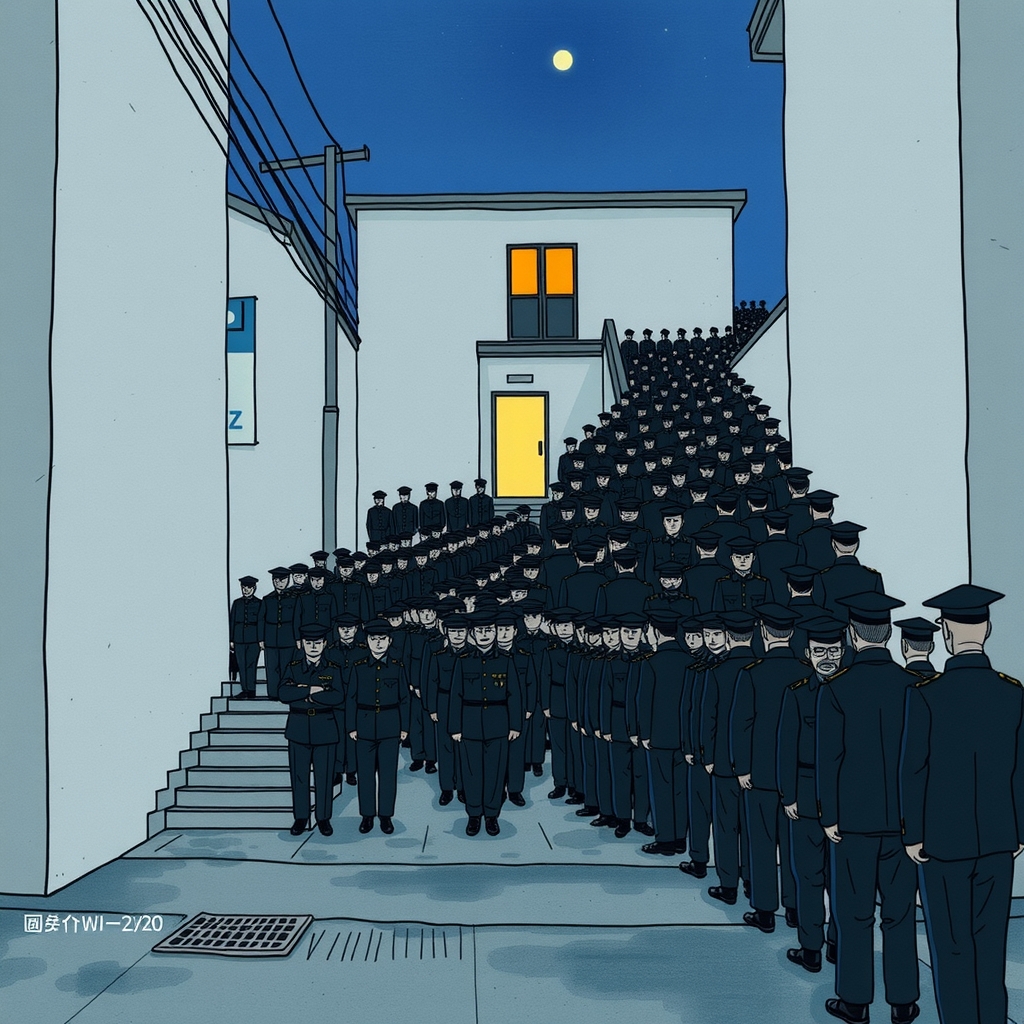
Eleven-Thirty at Night
The building sits in Shin-Shirakawa 2-chome, in a city of about 55,000 people in southern Fukushima Prefecture. The business police were interested in occupied the second floor and traded under the name UTOPIA.
At roughly 11:30 p.m. on Saturday, August 29, 2026, officers went in. According to the Fukushima Minyu, the search party numbered around 60 personnel — investigators from the Shirakawa Police Station together with units from prefectural police headquarters: the Investigation Support and Analysis Division, the Living Environment Division, and the Organized Crime Countermeasures Division.
The stated suspicion was narrow and specific: operating a business that provides settai — hospitality — along with food and drink, without the license the law requires. Police told the newspaper they intended to make arrests once they had secured sufficient evidence.
They had it within a day.
The Arrest
On August 30, Fukushima Broadcasting's KFB Digital reported that police had arrested Okuyama Tokiya, 28, a restaurant operator and a resident of Koriyama City, on suspicion of violating the fuei-ho — the Act on Control and Improvement of Amusement Business, etc., Japan's Businesses Affecting Public Morals Regulation Act.
The alleged offense is dated around 10:30 p.m. on August 29 — an hour before the officers came through the door. The allegation is that he provided hospitality to customers at the Shirakawa establishment he runs without holding a license to do so.
Police have not disclosed whether Okuyama admits or denies the allegation, telling reporters that releasing it could interfere with the investigation. Investigators are interviewing employees to establish how the business was run. No charge has been filed, and the allegation is unproven.
Neither outlet reported the establishment's staffing, its clientele, or how long it had been trading. Both describe it only as an eating-and-drinking establishment.
The Line Between a Bar and a Licensed Business
The offense at issue is easy to misunderstand, because nothing about it turns on alcohol, on the hour, or on anything sexual.
Under Article 2, paragraph 1, item 1 of the fuei-ho, a business that serves food and drink while providing settai to customers is a Category 1 regulated business — the same class that covers cabarets, hostess clubs and host clubs. Article 3 requires such a business to hold a license from the prefectural Public Safety Commission. Operating without one is the offense.
Settai is defined at Article 2, paragraph 3 as entertaining customers "in a manner that produces an atmosphere of pleasure." The National Police Agency's interpretive standards fill that in with conduct that is entirely ordinary in a small bar: sitting down beside a particular customer or small group and sustaining conversation with them, pouring their drinks, singing along, clapping and offering praise.
A bar whose staff stay behind the counter needs no license at all. If it serves alcohol after midnight it files a notification under Article 33 as a late-night liquor-serving establishment — a form, not an application, with no vetting. But that notification does not authorize settai. The moment an employee comes around the counter, sits down and starts entertaining, the business has changed legal category, and the paperwork it holds no longer covers it. It is then operating without a license, whatever time it is.
That is the boundary Fukushima police say UTOPIA crossed.
The Numbers Changed Last Year
Until recently, this was a comparatively minor charge. Unlicensed operation carried up to two years' imprisonment or a fine of up to ¥2 million, and where a company was prosecuted alongside the individual, the corporate fine was capped at ¥2 million as well.
The 2025 amendment to the fuei-ho — the most substantial overhaul of the statute in decades, driven largely by the political fight over predatory host clubs — rewrote those figures. For individuals, the maximum rose to five years' confinement or a fine of up to ¥10 million. For corporations, the ceiling went from ¥2 million to ¥300 million, a 150-fold increase.
The National Police Agency states that all provisions of the amendment were in force by November 28, 2025.
That timing is the quiet significance of a small-city raid. An arrest that in 2024 would have been a two-year offense is now, on paper, a five-year one — and if a corporate entity stands behind the business, the exposure is three orders of magnitude larger than it was. Nothing in the reporting indicates a company has been named in this case. But the schedule police are now working from is not the one that was in place the last time most operators looked it up.
Shirakawa Is Not an Exception District
There is a second clock running here, and it is set by Fukushima Prefecture rather than by Tokyo.
The prefecture's implementing ordinance for the fuei-ho fixes when licensed hospitality businesses may trade. Article 6 bars operation between 6 a.m. and 9 a.m., and — in the residential zones it specifies — from 11 p.m. until midnight. Article 5 then carves out named districts where trading may continue until 1 a.m. on New Year, Obon, year-end and festival dates. Those districts are in Fukushima City, Koriyama and the Taira district of Iwaki.
Shirakawa is not among them.
A licensed hospitality business in Shirakawa, in other words, closes at midnight. An establishment that wants the later hours has to give up the settai; one that wants the settai has to give up the hours. Officers arrived at 11:30 p.m., inside the window when a licensed venue could still legally have been trading — and an unlicensed one had nothing to hide behind either way.
January, Then August
The detail both outlets carried, and the one that turns this from a police-blotter entry into a story about method, is the visit that came first.
In January 2026, according to KFB, police conducted on-site guidance at the same Shirakawa establishment. Guidance — tachiiri shidō — is the low rung of Japanese vice enforcement: officers enter, inspect, explain which conduct requires which license, and leave without charging anyone. It is a warning with a paper trail.
Police say no improvement followed.
Roughly eight months later, sixty officers arrived at 11:30 at night. The sequence is not incidental to the case; it is the case. A January inspection establishes that the operator was told. An observation at 10:30 p.m. on August 29 establishes what was happening after being told. The raid an hour later collects the evidence. The arrest the next morning closes it.
It is the same escalation ladder Fukushima police have been climbing elsewhere this summer. Three days before the Shirakawa raid, officers in Iwaki arrested a man for touting on a street in Taira — the third such arrest in that city in ten weeks, after nineteen months with none. The instruments differ: a city ordinance in one case, a national statute in the other. The pattern does not. A period of documented warning, then a deployment sized to make the point.
What Comes Next
Okuyama can be held for questioning while prosecutors decide whether to seek an indictment. Police are still interviewing staff, and both outlets indicate the investigation into how the business operated is continuing. Whether other individuals or a corporate operator will be charged has not been reported.
For the roughly 55,000 residents of Shirakawa, the visible fact is a second-floor door on Shin-Shirakawa 2-chome and sixty police officers going through it on a Saturday night. For anyone running a small drinking establishment in the prefecture, the more useful fact is the one on the calendar: the guidance came in January, and the guidance was the offer.
Sources: Fukushima Minyu Shimbun, "Unlicensed hospitality business suspected; Shirakawa restaurant searched," August 30, 2026; KFB Fukushima Broadcasting, "Restaurant operator, 28, arrested on suspicion of violating the fuei-ho," August 30, 2026. Statutory provisions are drawn from the Act on Control and Improvement of Amusement Business, etc., and the Fukushima Prefecture ordinance implementing it; penalty figures for the 2025 amendment and its enforcement date are as reported by the National Police Agency and Japanese legal-practice sources. The suspect is presumed innocent, no charge has been filed, and police have not disclosed whether he admits or denies the allegation.