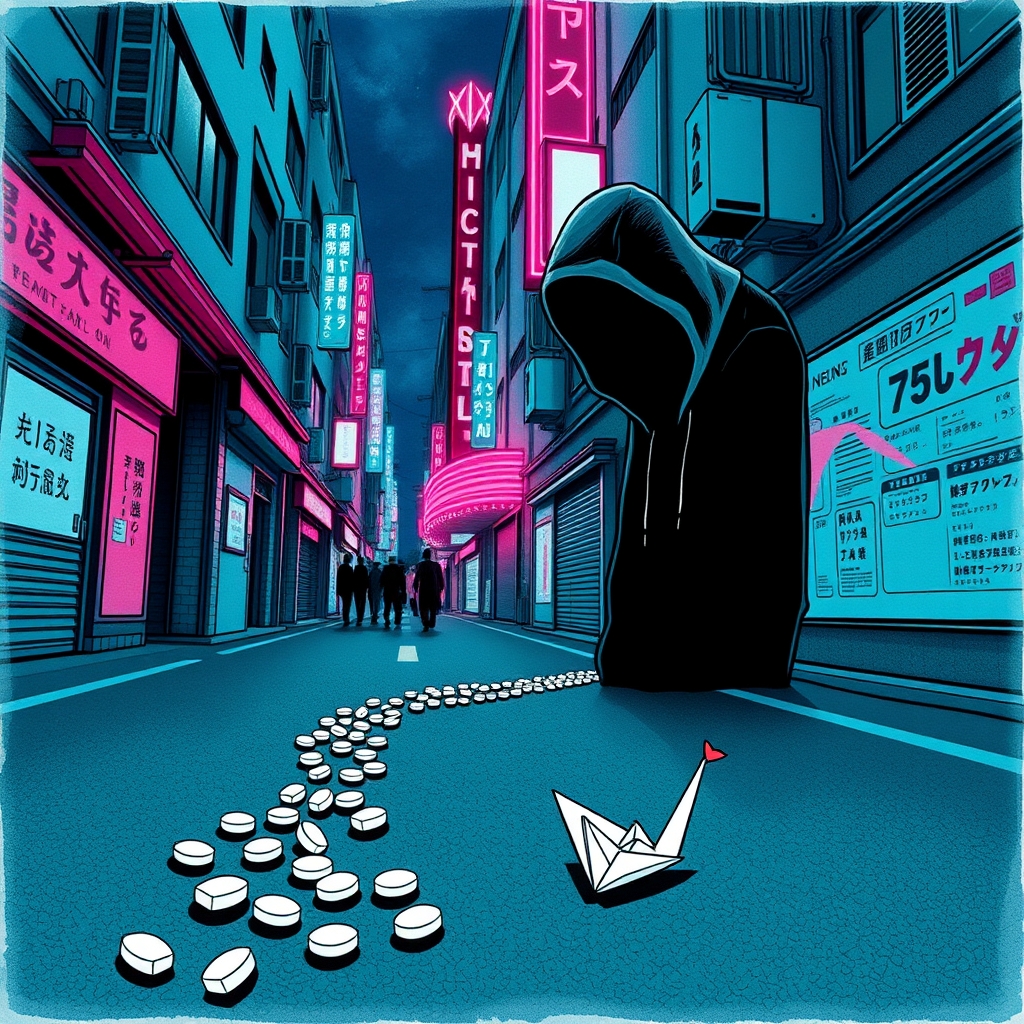
A Pill Economy With a Sex Trade Attached
The Tokyo Metropolitan Police Department's Juvenile Development Division re-arrested a 24-year-old unemployed man of no fixed address on July 24 on suspicion of violating the Narcotics and Psychotropics Control Act (mayaku torishimari-ho), alleging that he sold hundreds of prescription sedatives to a 16-year-old girl in Shinjuku's Kabukicho district.
What lifts the case above a routine drug arrest is the second allegation investigators attached to it. According to reporting on July 24 and 25 by the Sankei Shimbun, NHK, the Mainichi Shimbun, the Tokyo Shimbun and the broadcaster khb, police believe the man did not simply sell pills to minors who could afford them — he allegedly told a girl who could not afford them to go and earn the money with her body.
The suspect, whom this site is not naming, is widely known in the Toyoko scene — the stretch of pavement beside the Toho Building cinema complex in Kabukicho where runaway and at-risk teenagers gather — by the handle "Inocchi." Reports describe him as a fixture there with a social-media following of more than 50,000.
The Clinic Run
The mechanics police describe are unusually specific, and they turn on a feature of Japan's welfare system rather than on any black market import.
Investigators allege the man instructed girls from the Toyoko crowd to present themselves as patients at a clinic in Tokyo's Shinagawa Ward, in some cases accompanying them there himself. Because medical costs for children are effectively free under municipal child medical subsidy programs, the prescriptions cost the girls almost nothing. The man is then alleged to have taken the dispensed psychotropics — sleeping pills, tranquilizers and similar drugs — and resold them at Toyoko to multiple teenagers.
The Tokyo Shimbun, reporting on the initial arrest in this thread of the investigation, cited a woman in her twenties who described consultations at the clinic lasting roughly five minutes before a prescription was written.
Accounts of the volume differ. The Sankei Shimbun and khb put the specific count in the re-arrest at about 200 tablets sold for ¥90,000. NHK reported more than 400 tablets, and the Tokyo Shimbun put the May total at roughly 420 tablets for about ¥190,000. The transfers are alleged to have taken place in May 2026 in Kabukicho; the buyer is described as a first-year high school student, 16, from Kanagawa Prefecture.
| Detail | As reported |
|---|---|
| Charge | Narcotics and Psychotropics Control Act — transfer for profit |
| Re-arrested | Man, 24, unemployed, no fixed address; known online as "Inocchi" |
| Alleged buyer | Girl, 16, first-year high school student, Kanagawa Prefecture |
| Alleged period | May 2026, Kabukicho, Shinjuku Ward |
| Quantity | About 200 tablets / ¥90,000 (Sankei, khb); 400+ tablets, about ¥190,000 (NHK, Tokyo Shimbun) |
| Investigating unit | Metropolitan Police Department, Juvenile Development Division |
| Prior status | Already indicted in a separate case involving minors |
"Sell Your Body and Earn It"
The Tokyo Shimbun reported on July 25 that when the girl said she had no money for more pills, the man allegedly told her to sell her body to raise it. Investigators, according to that account and to the Mainichi's July 24 report, suspect the arrangement was designed to be self-sustaining in two directions at once: he is alleged to have encouraged the girls to overdose — "OD," in the vernacular of the district — so that demand would keep regenerating, and to have steered those who ran short of cash into paid sex so they could keep buying.
That is the point at which a narcotics case becomes a sex-industry case. Japan's Anti-Prostitution Act (baishun boshi-ho), the 1956 statute that anchors most enforcement in this area, does not punish the sale of sex itself. It punishes the apparatus around it — soliciting, procuring, providing a place, contracting to make a person engage in prostitution. Encouraging a minor into paid sex to service a drug debt sits squarely in the territory the law was written to reach, and it also implicates the child prostitution and child pornography statutes that carry heavier penalties where the person involved is under 18.
The man was already indicted in a separate case when the drug re-arrest came. The Sankei Shimbun described that earlier prosecution as covering Anti-Prostitution Act violations and other offenses; the Tokyo Shimbun referred to non-consensual sexual intercourse charges. Reports agree only that the prior case involved minors and that he was in custody when the new count was filed. Re-arresting a detained suspect on a fresh allegation is standard Japanese criminal procedure — it resets the detention clock and lets investigators assemble a case one statute at a time.
In questioning, according to the reporting, the man acknowledged the allegations. He told police he "well understood the dangers of overdose," and said a friend had told him money could be made this way, so he began selling around last winter.
Toyoko, Again
The case lands on well-worn ground. Kabukicho's Toyoko has drawn sustained police attention for several years as a gathering point for teenagers who have left home, and the enforcement around it has repeatedly shown the same structure: an adult with standing in the scene, a supply of something the kids want, and a debt that gets settled in sex.
Tokyo police mounted a large street-prostitution sweep in the district earlier this month, and a separate case in mid-July involved minors recruited through the underground idol circuit. The pattern investigators keep describing is less a marketplace than a closed loop — attention and drugs flowing one way, money and sexual labor flowing back — with the adults at its center holding the only position that pays.
None of the allegations has been tested in court, and the suspect has entered no plea in any judicial proceeding.
This article is compiled from July 24 and July 25, 2026 reporting by the Sankei Shimbun, NHK, the Mainichi Shimbun, the Tokyo Shimbun and khb (Higashi Nippon Broadcasting) on the re-arrest of a 24-year-old man on suspicion of violating the Narcotics and Psychotropics Control Act. The suspect's legal name is withheld here; the online handle, his age, the charge, the alleged May 2026 transfers in Kabukicho, the girl's age and prefecture, the Shinagawa clinic scheme, the alleged encouragement toward prostitution and overdose, and his statements to police are attributed to those outlets as published. Sources differ on the quantity and price, and both figures are given above as reported. Details of the earlier case against him are drawn from the same outlets' characterizations, which are not identical. The allegations have not been proven in court. Legal gloss: mayaku torishimari-ho = Narcotics and Psychotropics Control Act, under which transferring controlled psychotropics for profit is an offense; baishun boshi-ho = Anti-Prostitution Act, the 1956 law that penalizes soliciting, procuring, providing a place for prostitution and contracting to make a person engage in it, rather than the sale of sex itself; fuei-ho = Businesses Affecting Public Morals Regulation Act, the statute licensing Japan's adult-entertainment businesses. "Toyoko" refers to the area beside the Toho Building in Kabukicho, Shinjuku, where at-risk youth congregate; "papa-katsu" denotes transactional dating arrangements.