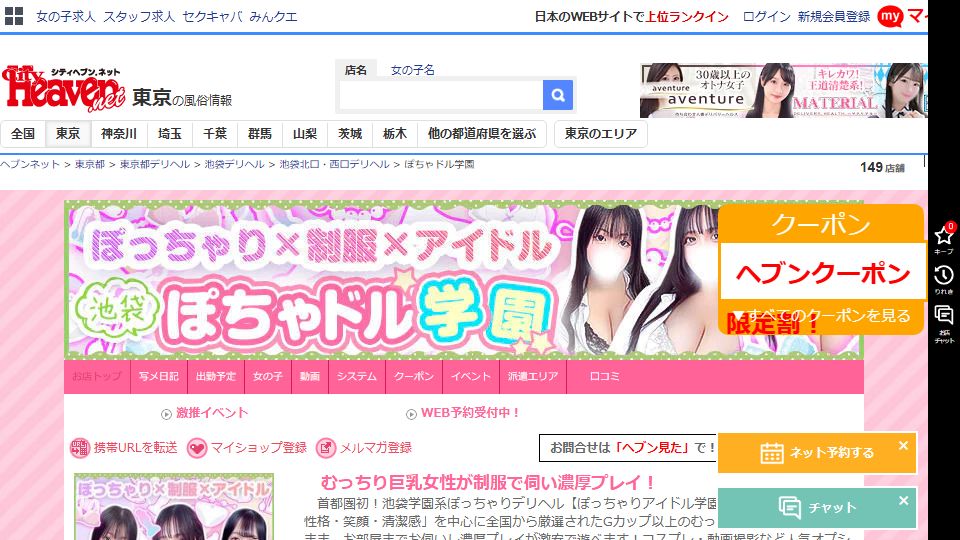

Let me tell you what Pocha Dol Gakuen actually is before the school-uniform sticker makes you file it wrong. It's a デリヘル — a delivery health, a deli-heru — working the North and West Exit side of Ikebukuro, Toshima Ward. Delivery, not storefront: there's no shop you walk into, no lobby, no bench. You call, you pick, and the cast comes to a hotel or a room you're already in. What separates this one from the forty other deli-heru numbers papering the same district isn't the delivery format, which is standard-issue. It's the single, unwavering thing it decided to be: a pocha shop — curvy, plus-size, deliberately well-endowed cast — wrapped in an "idol academy" frame. Pocha plus idol equals pochadol. The name is the entire business plan, and the business plan is smarter than the branding lets on.
The Segment Everyone Else Treats as a Footnote
Here's the mechanic worth reading past the costume. Walk the deli-heru listings for Ikebukuro and you'll see the same template a hundred times: "all types!" "every preference!" "slim to glamorous!" That's a general store, and a general store's promise to the customer who wants one specific thing is a shrug. The man who is actually looking for a curvy, soft, full-figured partner scrolls those "something for everyone" rosters and finds two girls out of thirty who fit, buried under a pile that doesn't. His demand is real, it's persistent, and the whole market is serving it as an afterthought. Pocha Dol Gakuen looked at that and did the obvious-in-hindsight thing: it built the entire shop for him. Every girl on the roster is the thing he came for. There's no filtering, no hoping, no "does she actually match the photo's implication." The specialization is the product, and specialization is what a general store can never copy without ceasing to be a general store.
The G-Cup Floor Is a Spec Sheet
The shop leans hard on a specific promise — cast built around G-cup and larger, curvy and soft, no bait-and-switch on the one axis the customer selected for. Read that not as a boast but as a spec sheet with a floor. The reason niche products win loyalty is that they make a legible promise and then actually hit it. When a general store says "glamorous available," that word is doing a lot of unpaid labor and the variance is enormous — you might get it, you might get a photo that lied. When a dedicated pocha shop sets a floor and holds it, the variance collapses. You know the shape of what's coming through the door before you dial. That's the same reason people trust a specialist over a department store for the one thing the specialist does: the specialist can't afford to miss on its single axis, because the single axis is the whole reason anyone chose it.
Why Delivery Is the Right Chassis for This Bet
Notice the shop chose the delivery format and not a storefront, and understand that the choice fits the strategy. A specialty storefront needs enough walk-by density of exactly its niche buyer to keep the lights on in a fixed location — brutal economics for a focused concept. Delivery decouples the shop from geography. It can serve the pocha-seeking customer anywhere across the North and West Exit zone and beyond without paying rent on a room he has to find and walk into. For a niche, that reach is oxygen: the whole point of specializing is that your buyer is a smaller slice of any given block, so you need to gather him from a wide radius. Delivery is the chassis that lets a narrow concept pull demand from a broad map. The format isn't incidental to the specialization — it's what makes a specialization this focused survivable in the first place.
The Pricing, Straight
No fog on my end. Pocha Dol Gakuen runs course pricing by time: roughly ¥11,000 for 60 minutes, ¥16,000 for 90, ¥21,000 for 120, ¥31,000 for 180, and ¥42,000 for the 240-minute block, with an entry fee around ¥2,000, a designation surcharge around ¥2,000, a name-request fee near ¥1,000, and 30-minute extensions around ¥8,000 on top. Hours run wide — roughly 9:30 in the morning straight through to 5:00 the next morning, no fixed closing day. Read the shape of that: an eleven-thousand-yen hourly floor is a mainstream mid-market entry, not a premium tax. The shop isn't charging extra for the specialization — it's charging the going rate and letting the focus be the differentiator. That's the confident move. A shop that believed its niche was a weakness would discount to apologize for it; one that knows the niche is the draw prices like everybody else and wins on fit.
The Verdict on the Roster
- Concept clarity: ★★★★★ — it is exactly one thing, unapologetically, and the name tells you what before you click.
- Promise legibility: ★★★★☆ — a G-cup-and-up floor is a spec with variance the general stores can't match on this axis.
- Format fit: ★★★★☆ — delivery is the right chassis to pull a narrow-segment buyer from a wide radius.
- Price honesty: ★★★★☆ — mainstream ¥11,000/hour floor with the standard add-ons; no apology discount, no niche surcharge.
- Going back: ○ — if you're the buyer this shop was built for, every other roster in the district just became noise.
I walked into the listing half-expecting the school-uniform "idol academy" wrapper to be the whole idea and the pocha angle to be a tag they stapled on for search traffic. Wrong read. The costume is the packaging; the actual product is a positioning decision most shops on this street were too timid to make — pick the segment everyone else serves as an afterthought and serve only that segment, all the way down. Where the general stores sell you a haystack with a couple of needles in it, this one sells the needle and nothing but. That's not the shop for the man who wants to browse every body type in Ikebukuro; that man has forty other numbers to dial. It's the shop for the man who already knows exactly what he wants and is tired of scrolling past thirty girls to find the two that fit. Order logged, roster matched the promise, and the specialization did precisely what specialization is supposed to do — it made the choice for me before I even picked up the phone.