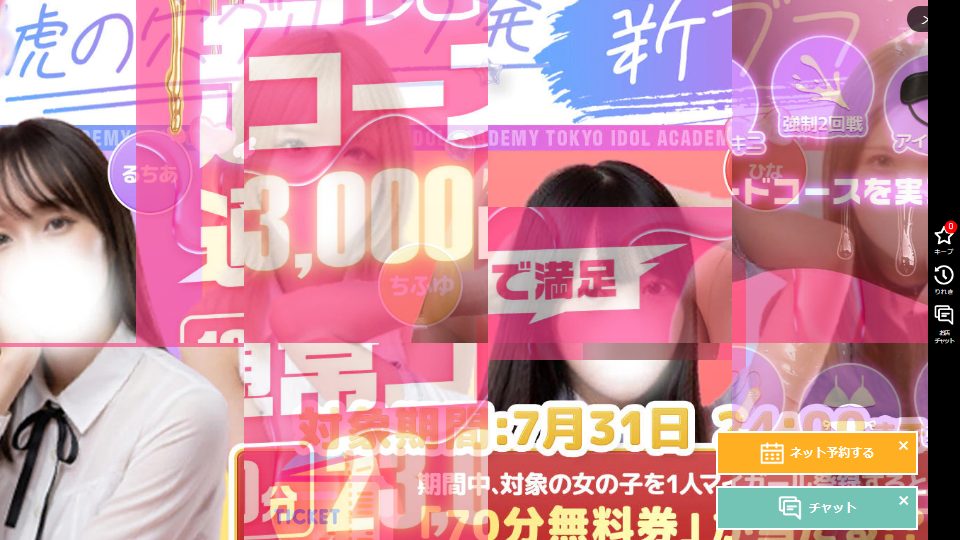

Let me start with the name, because the name is the entire thesis: TOKYO IDOL ACADEMY — "Boku Dake no Oshikatsu Life," which translates roughly to "my very own idol-support life." This is a delivery health shop — a deriheru — based in the Shinjuku Kabukicho area, dispatching across all 23 wards of Tokyo, open noon to 5 AM with no regular days off (reception starts at 10 AM). On the surface it's an ordinary school-and-idol-themed deriheru. But read the name one more time. It doesn't say "girls." It doesn't say "play." It says oshikatsu — and if you know what that word carries in Japan, you already understand why this shop is worth writing about.
The Word Doing All the Work
Oshikatsu — 推し活 — is the fan-activity of supporting your oshi, your favorite idol. It's an enormous, respectable, mainstream hobby in Japan: buying the CDs, going to the handshake events, collecting the goods, showing up to every show, spending real money not on a transaction but on a relationship you've decided to invest in. It is, crucially, an economy built entirely on emotional loyalty and repeat spending. And that is the single most expensive thing any business can manufacture from scratch. TOKYO IDOL ACADEMY didn't manufacture it. It borrowed it. By naming itself an "academy" full of "idols" you conduct your own personal "oshikatsu" with, the shop reframes the entire transaction. You're no longer a customer buying an hour. You're a supporter backing your favorite. That's not a paint job — it's a total conversion of the customer's psychology, done with a single loaned word.
What the Reframe Actually Buys the Shop
Here's why the idol framing is a business masterstroke and not just cute copy. A standard deriheru sells discrete, forgettable transactions — a man books, a man leaves, and the shop has to win him back from zero next time. The oshikatsu frame installs a completely different logic: the logic of the fan. A fan doesn't shop around; a fan has an oshi and stays loyal to her. A fan doesn't buy once; a fan supports repeatedly, and feels good about it. A fan doesn't resent the spending; a fan experiences it as devotion. By dressing its roster as idols and its customers as supporters, the shop is quietly trying to convert one-shot buyers into recurring, loyal, emotionally-invested regulars — the single most valuable customer type any service business can own. It's a customer-retention strategy disguised as a theme. The "academy" isn't the gimmick. The loyalty it's engineering is the gimmick, and the theme is just the delivery vehicle.
The Course, in Plain Numbers
Strip the theme away and here's what you're actually buying, which the shop states plainly: a 100-minute course at ¥23,000 — currently discounted 18% from a ¥28,000 list price — with the standard kit bundled in: lotion bath, eye mask, vibrator, and a micro bikini as the costume. Longer courses advertise a "forced second round" as the headline perk. I appreciate that the concrete offer is stated without weasel words; whatever you think of the idol dressing, the actual product and its price are on the table where an adult can read them. The list-versus-discount move (¥28,000 crossed out, ¥23,000 in front of it) is the oldest anchor in retail — the higher number exists to make the lower one feel like a win — but there's nothing hidden about it. You know what the hour costs and you know what's in it before you dial.
Renting Kabukicho, Owning Nothing
And underneath all the fandom theater sits a beautifully light body. As a deriheru based in Shinjuku but dispatching to all 23 wards and to hotels and residences, the shop owns no rooms, no storefront, no fixed real estate bleeding rent while it sleeps. Transport is free inside the Shinjuku/Okubo home turf and capped at ¥5,000 elsewhere — a clean, legible rule that keeps the near trade frictionless and makes the far trade pay for its own gas. The seventeen-hour window, noon to 5 AM, straddles the after-work crowd and the deep-Kabukicho-night crowd off a single lean base. Asset-light delivery plus a borrowed emotional economy: the fixed costs are almost nothing, and the marketing — the hardest, most expensive part — was outsourced years ago to a subculture that did the work for free.
The Verdict on the Setup
- Concept/branding: ★★★★★ — borrowing "oshikatsu" wholesale is the cheapest marketing in the business; it converts a transaction into a fandom without spending a yen on building one.
- Retention design: ★★★★☆ — the idol frame is engineering repeat, loyal, emotionally-invested regulars, which is the most valuable customer any service shop can own.
- Price transparency: ★★★★☆ — ¥23,000 for 100 minutes, kit itemized, the discount anchor visible and honest; you know the deal before you dial.
- Cost structure: ★★★★★ — Kabukicho base, 23-ward dispatch, seventeen-hour window, capped transport: asset-light and legible where it counts.
- Going back: ○ — the whole machine is built to make "going back" feel less like a repeat purchase and more like supporting your oshi; that's precisely the trap, and it's a well-built one.
I came to TOKYO IDOL ACADEMY expecting another school-costume deriheru with a cute name and left convinced I'd been reading a retention strategy wearing a micro bikini. The genius isn't the ¥23,000 course or the lotion bath or the "forced second round" — that's just a competent, honestly-priced hundred minutes like a hundred other Kabukicho shops sell. The genius is the word. By calling itself an academy and its women idols and its customers supporters, the shop reaches past the one-night transaction and grabs at the thing every business actually wants and almost none can afford to build: loyalty that feels like devotion. It borrowed that loyalty, fully assembled, from a subculture that spent a generation manufacturing it — and then it stapled the whole apparatus onto an asset-light delivery base with almost no fixed cost behind it. This isn't the shop for the man who wants a plain transaction and no story; that man should book somewhere that doesn't ask him to feel anything. It's the shop for the man who understands, and maybe even enjoys, that he's being invited to become a fan. Setup logged — and the smartest thing on the page was borrowed, not built.