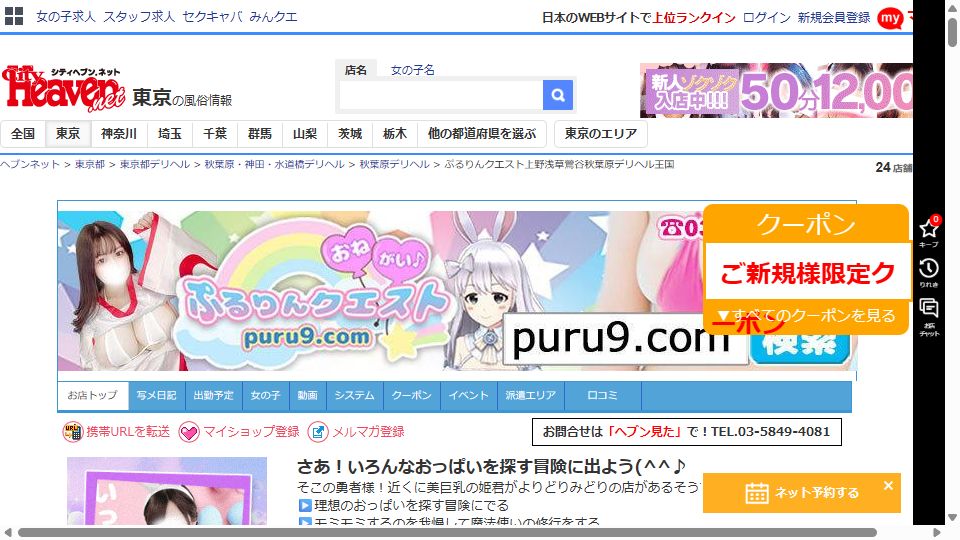
Most write-ups of a place like this get stuck at the wrapping paper. I want to open the box, because Pururin Quest (ぷるりんクエスト) wraps itself in a lot of paper: an RPG-fantasy "quest" theme, a hard focus on oppai — big busts — and free cosplay thrown in once you clear a certain course length. It's a delivery health that dispatches across the Ueno–Asakusa–Uguisudani–Akihabara corridor in Taito Ward, and on the surface it's pure Akiba theatrics. But read past the theme and there's a very un-whimsical operation underneath, and that contrast is the whole story.
Reading the Price Ladder Instead of the Costume
Start where the marketing hopes you won't: the numbers. The door is 60 minutes for ¥15,000. Step up to 80 minutes for ¥18,000 and the cosplay is free — that's the hinge of the whole menu. Then 120 minutes for ¥28,000 and 180 minutes for ¥44,000 for the long haul. Look at the jump from 60 to 80: three thousand yen buys you twenty more minutes and the costume that the entire brand is built around. That's not an accident of pricing; that's a shop quietly steering every rational customer past the 60-minute door and into the 80. The theme isn't a tax bolted on top — it's the free bait that makes the more profitable course the obvious choice. Whoever set that ladder has done this before.
The Hours Are the Tell
Now the operating window, which is where the fantasy drops away entirely. Pururin Quest runs 11:00 AM to 7:00 AM the next morning, with the last booking at 5:00 AM. Sit with that. A twenty-hour daily window is not something a novelty shop can staff. A gimmick with a thin roster has "sold out" nights, dead afternoons, phones that ring out at 4 AM. A twenty-hour clock, by contrast, is only possible if the bench behind it is deep enough to rotate women through morning, evening, and the small hours without the board going dark. The quest branding is the marquee; the 11-to-7 schedule is the load-bearing wall. And the two facts together tell you the theme is riding on top of a genuine dispatch operation, not standing in for one.
What "24 Branches, 1,500-Plus Staff" Actually Means
Here's the number that reframes everything: the brand behind this listing runs on the order of two dozen branch areas and well over a thousand women across the network. For a corner of the market that looks, from the outside, like a cosplay novelty, that's an industrial footprint. What a network that size buys the customer isn't spectacle — it's coverage. Book from a hotel in Uguisudani, from Akihabara, from Ueno or Asakusa, at almost any hour, and the machine can put someone in a cab toward you, because the pool it's drawing from is enormous. The RPG theme is the storefront a first-timer remembers; the multi-branch scale is why the booking actually lands. People think they're buying the fantasy. What they're really buying is dispatch density dressed up as a quest.
The Treasure Box Is Just CRM in Cosplay
The theme even bleeds into the promos: a "gold treasure box" that coughs up a ¥1,000–¥5,000 discount. It's cute, it fits the RPG skin, and it is — underneath — exactly the kind of variable-reward hook that keeps people coming back to reopen the box. That's not a knock. A shop that bothers to build a repeat-visit mechanic, and to wrap it in the same fantasy language as the rest of the brand, is a shop thinking past tonight's single booking toward the regular who comes back next month to roll the dice again. The gimmick and the retention strategy are the same object. That's the sign of a brand that actually understands its own theme rather than just wearing it.
The Verdict on the Quest
- Theme-vs-substance: ★★★★☆ — the RPG-oppai-cosplay skin is real branding, but it sits on a genuine twenty-hour, multi-branch operation, not in place of one.
- Price architecture: ★★★★☆ — free cosplay at the 80-minute tier is a clean piece of menu design that makes the better course the obvious one; ¥15k door, ¥18k/80, ¥28k/120, ¥44k/180.
- Coverage & reliability: ★★★★★ — 11 AM to 7 AM across the Ueno–Asakusa–Uguisudani–Akihabara corridor, backed by a network big enough to actually answer at odd hours.
- Retention design: ★★★★☆ — the treasure-box discount is a repeat-visit hook in fancy dress, and it tells you the brand is playing a long game.
- Going back: ○ — if the oppai-and-cosplay concept is your lane, the 80-minute tier is the sweet spot and the machine behind it is more serious than the packaging lets on.
I came to Uguisudani half-expecting a novelty — a cosplay gimmick with a thin bench and a cute logo. What I found reading the fine print was the opposite: a fantasy storefront bolted onto a large, coldly-competent dispatch operation that runs twenty hours a day across four of Tokyo's busiest districts and knows exactly how to price a costume to move you up the menu. The quest theme is the part you'll remember and the part that gets you in the door. But the reason the door is worth walking through isn't the RPG paint job — it's the machine idling behind it, the one deep enough to send someone your way at five in the morning. The gimmick, it turns out, was never hiding the operation. It was the operation's uniform the whole time.