
Tachikawa is what Tokyo looks like when it stops performing. Forty minutes out on the Chuo Line, past the point where the rapid trains stop pretending and just go, and you come up out of a station that handles more passengers in a day than most prefectural capitals see in a week. There's no Shibuya scramble here, no tourist with a gimbal walking backwards into you. What there is instead is a genuine city — the kind with its own department stores, its own courthouse, its own gravitational pull on four surrounding municipalities — that happens to sit thirty kilometers west of the Imperial Palace and gets called a suburb by people who have never been.
The pedestrian decks are the giveaway. Tachikawa built its downtown on a second story, elevated walkways strung between the station and the department stores and the wide flat blocks beyond, so you can cross most of the center without ever touching the street. Below the decks, in the low buildings on the south side, is the other Tachikawa: the izakaya alleys, the business hotels that fill up on weekday nights with men from Hachioji and Fussa who missed the last train, and the phone numbers that serve them.
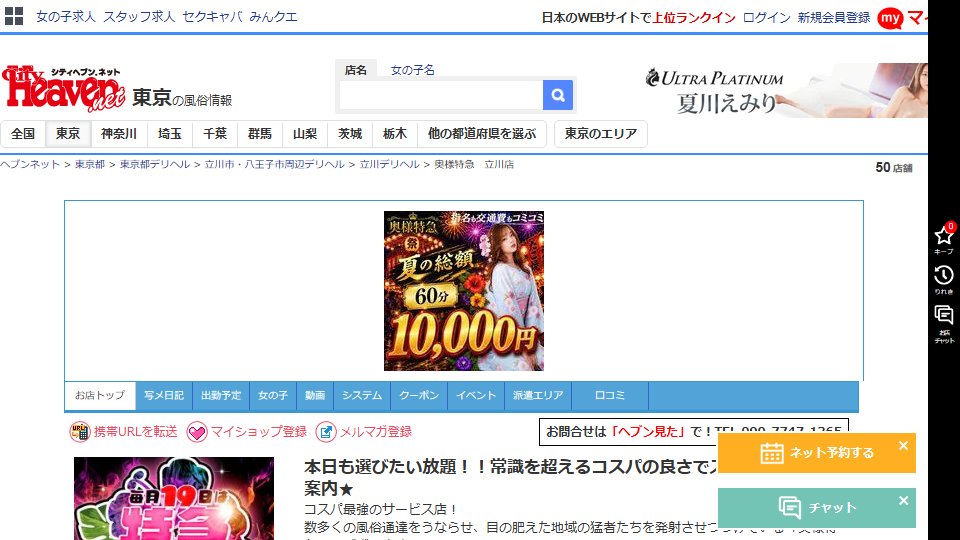
Okusama Tokkyu Tachikawa-ten — 奥様特急 立川店, オクサマトッキュウ タチカワテン, Tel 090-7747-1365 — is one of those numbers. Cityheaven files it as デリヘル(人妻/立川): delivery health, hitozuma tier, Tachikawa. Hours 10:00 to 05:00, listed as 年中無休 — no closing day, all year. Dispatch area: Tachikawa City, with rings extending well past it. Official site at tachikawa.0930-exp.com, group site at exp-g.com.
Note the domain before we go any further, because it tells you who you're dealing with. 0930 is goroawase — Japanese number-punning — for okusama, "wife." And exp is express. The shop's name, 奥様特急, means Wives Limited Express, which in a city whose entire identity is a railway junction is either a very good joke or an accident so lucky it might as well be one. A tokkyū is the fastest scheduled service on the line. Fewer stops. Gets there first.
Hold onto that, because speed turns out to be the entire product.
The slogan is a beef bowl slogan
The shop's own concept text opens with this:
当店のウリはなんといっても、選び放題、早い、美味い、安い!!!
Our selling point, above all: unlimited choice — fast, tasty, cheap.
If that last trio rings a bell, it should. 早い、美味い、安い is, word for word and near enough in order, the Yoshinoya beef bowl slogan — the one that's been on gyudon shop signage in this country for decades. A delivery health in Tachikawa has branded itself as a fast food chain, on purpose, in its first paragraph.
I've read a few hundred of these listings and I want to be clear that this is not the usual move. The standard hitozuma shop sells you a fantasy of duration: the lonely wife, the slow afternoon, the pretense of a relationship. Okusama Tokkyu sells you a service level agreement. Look at what the concept text promises next:
奥様特急は時間の引き延ばし、サービス地雷の撲滅運動を行っております。
Okusama Tokkyu is running an eradication campaign against time-padding and service landmines.
時間の引き延ばし — time-stretching, the practice of filling your paid minutes with small talk and shower and getting dressed. サービス地雷 — a "service landmine," the industry term for the woman who shows up and visibly does not want to be there. The shop is naming the two most common complaints in the entire genre and positioning against them. And it backs this with a stated structure: the door opens and it starts immediately, then a 2度抜き — two finishes — with a massage in the middle, during what the text calls the cool time.
That structure is the actual thesis. The shop's answer to "what am I buying" is not intimacy, it's throughput. Which is a real position, honestly held, and it means the whole listing should be judged on price per minute. So let's judge it on price per minute.
Board one: the official course list
Seven courses and an extension, exactly as printed:
| Course | Price | Per minute |
|---|---|---|
| Trial — 30 min | ¥7,800 | ¥260.00 |
| 50 min | ¥11,000 | ¥220.00 |
| 70 min | ¥13,000 | ¥185.71 |
| 100 min | ¥18,000 | ¥180.00 |
| 130 min | ¥23,000 | ¥176.92 |
| 180 min | ¥31,000 | ¥172.22 |
| 240 min | ¥46,000 | ¥191.67 |
| +30 min extension | ¥7,000 | ¥233.33 |
First, the headline, because it deserves saying plainly: these are cheap. The benchmark I keep coming back to on this site is ¥300 a minute — the rate I've measured independently at delivery healths in Shibuya, sexy cabarets in Kanda, and esthe shops in Ikebukuro, arrived at by shops that share nothing but a city. Three hundred yen a minute is what an hour costs in central Tokyo.
Okusama Tokkyu's worst per-minute rate — the 30-minute trial, the most expensive slot on any board anywhere — is ¥260. Its best is ¥172. The 180-minute course is running at 57% of the central Tokyo rate. The コスパ最強 claim in the marketing copy is doing what marketing copy almost never does, which is telling the truth.
Second: look at the shape of that column. It descends cleanly — 260, 220, 186, 180, 177, 172 — and then, on the last row, it jumps back up to 191.67.
The 240-minute course is the worst deal on the board
That reversal isn't a rounding artifact. It's a real and expensive break in the curve, and you can beat it using the shop's own numbers.
The extension is ¥7,000 for 30 minutes. So:
| Route to 240 minutes | Arithmetic | Total |
|---|---|---|
| Buy the 240-minute course | ¥46,000 | ¥46,000 |
| Buy 180, then extend twice | ¥31,000 + ¥7,000 + ¥7,000 | ¥45,000 |
One thousand yen cheaper, same four hours, using a price the shop prints on the same page. The 240-minute course is the only item on the official board that is strictly dominated by another combination on the official board.
Run the marginal cost to see why. Going from the 180 to the 240 costs you ¥15,000 for sixty extra minutes — ¥250 a minute for that last hour, which is nearly the trial-course rate and 45% above what you were paying for the first three hours. The extension, at ¥233 a minute, is cheaper. Not by a lot. But it's the shop's own escape hatch out of its own worst price, and it's sitting right there four rows up.
Now, the caveat, and it's a fair one: an extension has to be available. You're asking a woman to stay another half hour when she may have somewhere to be, and the shop has to agree to hold her. The 240-minute course guarantees the block up front. If you actually need four uninterrupted hours locked in, ¥1,000 is a reasonable insurance premium and I'd pay it too. But you should know you're buying insurance, not time, and nothing on the page tells you that.
Below the top of the board, incidentally, the extension is a bad move and the courses win comfortably:
| 130 minutes, two ways | Arithmetic | Total |
|---|---|---|
| 130-minute course | ¥23,000 | ¥23,000 |
| 100-minute course + extension | ¥18,000 + ¥7,000 | ¥25,000 |
Two thousand yen worse. The rule that falls out: buy the longest course you actually want, and only reach for the extension once you've run out of board.
The fees, and the loyalty penalty
Two designation fees:
| Fee | Price |
|---|---|
| 写真指名料 — picking from photos | ¥1,500 |
| 本指名料 — asking for someone you've had before | ¥2,500 |
Read those in the right order. Choosing a stranger from the gallery costs ¥1,500. Asking for the same woman a second time costs ¥2,500.
That's a ¥1,000 premium on continuity, and I want to be careful about how I characterize it, because the honshimei premium is close to universal in this industry and Okusama Tokkyu did not invent it. The industry rationale is that honshimei is where a woman's own repeat business lives, and a portion of that fee typically reaches her. It is not a scam. It is arguably the most defensible fee on any board in the genre.
But it is worth naming what it does to the customer, particularly at this shop. Okusama Tokkyu's entire pitch is anti-landmine — come to us and you won't get the woman who doesn't care. The natural consumer response to a shop that solves the landmine problem is: find one who's good, and go back. And the price list charges you an extra ¥1,000 every single time you do that. The shop's fee structure quietly taxes the exact behavior its marketing copy is designed to produce.
Hold that thought too. The campaign board is about to make it disappear.
Transport: five rings, and how fast they eat a short course
The dispatch map is unusually explicit, which I appreciate — most shops write "consult us" and let you find out at the door.
| Zone | Coverage | Fee |
|---|---|---|
| Free | Hotels around Tachikawa Station | ¥0 |
| Within 3 km | — | ¥1,000 |
| Within 6 km | Kokubunji, Akishima, Kunitachi, Hino | ¥2,000 |
| Within 9 km | Hachioji Station area, Fuchu, Fussa, Tama, Higashi-Yamato | ¥3,000 |
| Within 15 km | Hachioji City, Machida, Chofu, Tokorozawa, Nishi-Tokyo, Mitaka, Higashi-Kurume | ¥4,000 |
| Beyond 25 km | — | Negotiate |
Note Tokorozawa in the ¥4,000 ring. That's Saitama. This shop's delivery radius crosses a prefectural border, which tells you something real about where Tachikawa sits: it isn't a Tokyo neighborhood with a hinterland, it's the commercial center of a region that ignores the prefecture line entirely.
Now the part that matters to your wallet. The transport fee is flat, so its damage is inversely proportional to how long you booked. Take the trial course:
| 30-minute trial, by zone | Course + photo shimei + transport | Effective ¥/min |
|---|---|---|
| Station hotel | ¥7,800 + ¥1,500 + ¥0 = ¥9,300 | ¥310.00 |
| Kokubunji (¥2,000) | ¥7,800 + ¥1,500 + ¥2,000 = ¥11,300 | ¥376.67 |
| Machida (¥4,000) | ¥7,800 + ¥1,500 + ¥4,000 = ¥13,300 | ¥443.33 |
From Machida, the fees and transport add ¥5,500 to a ¥7,800 course — a 71% surcharge — and the cheapest shop in western Tokyo suddenly bills out at ¥443 a minute, which is Roppongi money. The ¥4,000 transport charge alone is 51% of the trial course price.
The same fees on the 180-minute course barely register: ¥31,000 + ¥1,500 + ¥4,000 = ¥36,500, or ¥202.78 a minute, still comfortably under the Tokyo standard. Fixed fees punish short bookings. That's not a Tachikawa insight, it's arithmetic, but the size of the effect here is unusual because the base rate is so low that the fees are large relative to it.
The free-option ladder, and the ceiling nobody mentions
The option menu is tiered:
| Tier | Items | Price |
|---|---|---|
| Free | Vibe, rotor | ¥0 |
| Paid 1 | Denma | ¥1,000 |
| Paid 2 | Four items, including sokusoku (immediate start) | ¥2,000 each |
| Paid 3 | Three items, ¥3,000 / ¥3,000 / ¥5,000 | ¥3,000–5,000 |
And the longer courses include some of them:
| Course | Included paid options |
|---|---|
| 70 min | 1 free |
| 100 min | 2 free |
| 130 min | 3 free |
With one asterisk, printed in small type directly underneath:
※有料オプション3は除外となります。
Paid option tier 3 is excluded.
So the maximum cash value of those "free options" is capped at ¥2,000 apiece. Let's price the ladder honestly:
| Course | Price | Max option value | Net | Effective ¥/min |
|---|---|---|---|---|
| 70 min | ¥13,000 | ¥2,000 | ¥11,000 | ¥157.14 |
| 100 min | ¥18,000 | ¥4,000 | ¥14,000 | ¥140.00 |
| 130 min | ¥23,000 | ¥6,000 | ¥17,000 | ¥130.77 |
That's the real reason to climb the board. The 130-minute course, if you use all three included options at the top of the permitted tier, is running at ¥131 a minute of net value — 44% of the central Tokyo rate. It's the best-value single item on the official list by a distance, and the per-minute column further up doesn't show you that, because the per-minute column doesn't know about the options.
Two honest caveats. First, that ¥6,000 is a ceiling, not a value — if the options you actually want are the ¥1,000 denma or nothing at all, the discount is smaller or zero, and the plain per-minute numbers are the ones that apply to you. Second, the ladder stops at 130. The page says nothing about what the 180 and 240-minute courses include. It may be three, it may be more, it may be that nobody updated the table when the long courses were added. I'm not going to guess. But if you're booking either of the two longest courses, that's the question to ask on the phone, because at ¥2,000 a unit it's real money and the page has simply left it blank.
Board two: the summer all-in campaign, and the two exact matches
Further down the listing, under 残暑きびしーーー — the late-summer heat is brutal — is a promotional block titled 『夏の総額祭り!』, the Summer All-In Festival. Four courses. The critical word is 総額 — sōgaku, all-in, total. Every price is tagged 指名交通費込み: designation and transport included.
| All-in course | Price | Per minute |
|---|---|---|
| 60 min | ¥10,000 | ¥166.67 |
| 90 min | ¥14,500 | ¥161.11 |
| 120 min | ¥18,500 | ¥154.17 |
| 150 min | ¥24,500 | ¥163.33 |
Same curve shape as the official board — descending, then breaking upward at the top. The 120 is the value floor at ¥154.17; the 150 costs you ¥6,000 for thirty more minutes, or ¥200 a minute for that last half hour. Same trap, different location on the board.
But look at the lengths: 60, 90, 120, 150. The official board runs 30, 50, 70, 100, 130, 180, 240. The two grids do not share a single number. You cannot lay them side by side and compare a row to a row, which is exactly why almost nobody does.
So I laid them side by side anyway, matching each campaign course against the official course twenty minutes shorter, with the photo designation fee added:
| Campaign | Price | Official course 20 min shorter, + ¥1,500 photo shimei | Difference |
|---|---|---|---|
| 90 min | ¥14,500 | 70 min: ¥13,000 + ¥1,500 = ¥14,500 | ¥0 — exact |
| 150 min | ¥24,500 | 130 min: ¥23,000 + ¥1,500 = ¥24,500 | ¥0 — exact |
| 120 min | ¥18,500 | 100 min: ¥18,000 + ¥1,500 = ¥19,500 | campaign ¥1,000 cheaper |
| 60 min | ¥10,000 | 50 min: ¥11,000 + ¥1,500 = ¥12,500 | campaign ¥2,500 cheaper |
Two of them land on the exact yen. Not approximately. Not within a rounding step. ¥14,500 = ¥14,500. ¥24,500 = ¥24,500.
That is not a coincidence and it isn't a discount either. It's a rebuild. Somebody sat down with the official board, took each course price, added the photo designation fee, and made that number the sticker price of a course twenty minutes longer — with transport thrown in and the option menu opened up. The campaign isn't 20% off anything. It's the same money for a different product.
And on the two courses where the pattern breaks, it breaks in your favor: the 120 undercuts the equivalent by ¥1,000, and the 60 undercuts it by ¥2,500 while also giving you ten more minutes than the 50.
So here is the finding, stated as plainly as I can: on this listing, reading the official price list and stopping there costs you twenty minutes and your transport fare. The board under the 料金システム heading is not the price. It's the price of not scrolling.
What the campaign actually erases
Stack the inclusions, because 指名交通費込み is six characters carrying a lot of weight:
One — the designation fee, both kinds. The campaign text says 本指名様も利用可 explicitly: honshimei customers may also use this. So the ¥2,500 loyalty penalty I flagged earlier — the one that taxes you for going back to a woman who was good — is simply gone on the campaign board. That's the single most customer-favorable line in the entire listing, and it's buried in a promotional banner.
Two — transport, at any distance in the fee table. Worth ¥0 if you're in a station hotel and ¥4,000 if you're in Machida. Which means the campaign's real value scales with how far out you live, and the people it helps most are precisely the ones the official board punishes most.
Three — the options. The wording here is 女の子が使えるオプションももちろんすべて無料 — all options the girl can use are, of course, free. I'll flag this as the one soft spot on the campaign board: that phrasing is looser than the official ladder's, and it doesn't repeat the tier-3 exclusion. It might mean everything. It might mean the same tier-1-and-2 set. I don't know, the page doesn't say, and I'm not going to invent an answer. Ask.
Now watch what happens when you put a realistic booking through both boards. Say you're in Kokubunji — ¥2,000 ring — you've been before, and you want a woman you've had:
| Route | Arithmetic | Total | Minutes | ¥/min |
|---|---|---|---|---|
| Official: 130-min course | ¥23,000 + ¥2,500 honshimei + ¥2,000 transport | ¥27,500 | 130 | ¥211.54 |
| Campaign: 150-min all-in | ¥24,500, everything included | ¥24,500 | 150 | ¥163.33 |
Three thousand yen less for twenty more minutes. A 23% better rate, for scrolling further down the same page.
The ¥700 that buys you thirty minutes
This is the comparison I'd put on the wall.
The trial course exists to convert first-timers: 30 minutes, ¥7,800, the cheapest number anywhere on the listing and the one your eye lands on. But you can't book it without picking somebody, so the photo designation fee applies:
¥7,800 + ¥1,500 = ¥9,300 — thirty minutes, transport not yet included.
The cheapest campaign course:
¥10,000 — sixty minutes, designation included, transport included, options included.
Seven hundred yen. That's the entire gap. For ¥700 more than the trial, you get double the time, your transport covered anywhere in the fee table, and the option menu opened. If you're calling from Machida, the campaign 60 is ¥3,300 cheaper than the trial course and still twice as long.
Which means the 30-minute trial course, as currently priced against the campaign running on the same page, has almost no rational buyer. The only case I can construct for it is a hard thirty-minute hole in your schedule and nowhere to put a longer one. If you have an hour — and the shop is open nineteen hours a day, so you can usually find one — the trial is the worst purchase on the listing.
The roster, and what the word okusama is doing
I pulled the shop's cast page and counted. One hundred women listed, which for a single delivery health outside central Tokyo is a genuinely large book — and it substantiates the 選び放題 claim, the "unlimited choice" that leads the marketing copy. Whatever else is true, the selection is real.
The advertised ages, tallied:
| Band | Count | Share |
|---|---|---|
| 18–20 | 36 | 36% |
| 21–24 | 27 | 27% |
| 25–29 | 20 | 20% |
| 30–39 | 17 | 17% |
Range 18 to 39. Median: 23. Modal age: 20, with eighteen women listed at it.
Now hold that against the branding. The shop is called 奥様特急 — Wives Limited Express. Cityheaven files it under 人妻, married women. Every piece of copy on the page leans on it.
There are more 20-year-olds on this roster (18) than there are women over thirty (17). Fifty-seven percent of the book is 24 or under.
I don't raise this as a gotcha. In Japanese fūzoku, 人妻 functions as a genre tag, not a demographic claim — it describes a register of service and presentation, and the industry has understood it that way for a long time. Nobody is being defrauded. But an English-reading first-timer sees "wives" and "hitozuma" and builds a mental picture that this roster does not match, and since ¥1,500 of your money is riding on picking correctly from photographs, the actual distribution is worth knowing before you call. If you specifically want the older end, it's there — seventeen women — but it's a sixth of the book, not the book.
One footnote for the pattern-noticers: there is not a single 29-year-old on the list. The ages run 26, 27, 28, and then jump straight to 30. Twenty-nine is missing entirely. With a hundred entries and advertised ages clustering the way advertised ages do, that's the sort of gap that tells you these are marketing numbers rounded to marketing intuitions rather than dates of birth — which anyone in this industry could have told you, but it's nice to watch it show up in the data.
The Niigata tell
The sister-shop list at the bottom is short and worth reading:
| Sister shop | Location |
|---|---|
| 奥様特急 池袋・大塚店 | Ikebukuro / Otsuka, Tokyo |
| 奥様特急 水戸・ひたちなか店 | Mito, Ibaraki |
| 奥様特急 新潟店 | Niigata City |
| 人妻・熟女特急 新潟店 | Niigata City |
| 奥様特急 長岡店 | Nagaoka, Niigata |
| 奥様特急 三条店 | Sanjo, Niigata |
| 奥様特急 上越店 | Joetsu, Niigata |
Five of the seven are in Niigata Prefecture. This is not a Tokyo chain with regional branches. It's a Niigata chain, built across four separate Niigata cities, that has since put down two outposts in Tokyo and one in Ibaraki.
That reframes the pricing entirely. The ¥172-a-minute floor isn't a Tokyo shop being generous — it's a regional cost structure walking into the Tokyo market and not adjusting. Niigata prices in Tachikawa. And it explains the choice of beachhead: not Shinjuku, not Ikebukuro first, but Tachikawa — a big self-contained city thirty kilometers out, where a chain that knows how to operate in Nagaoka and Joetsu is on familiar ground and doesn't have to fight central Tokyo's rent and competition to prove the model works.
It also explains the gyudon slogan. Fast, tasty, cheap is a provincial-highway value proposition. It's how you compete in a city of 270,000, not how you compete in Kabukicho. They brought it with them.
The listing's other tells, briefly
Nineteen hours a day, 365 days a year. 10:00 to 05:00, 年中無休. A hundred women and a nineteen-hour window is the operational backbone under the 早い claim — it's what lets a shop answer the phone at two in the afternoon on a Tuesday and again at four in the morning and have somebody available both times.
The 即ヒメ block. The listing carries a "play right now" panel with a live 待機中 timestamp on it. That's a real-time availability feed, and it's the most useful widget on the page if you're deciding at eleven in the morning whether to bother calling. It's also, structurally, the tokkyū promise made literal: the shop is publishing who is idle at this moment.
"ヘブン見た" で! — say you saw us on Heaven. Standard, and worth doing; it's how the shop attributes the listing and it smooths the call.
The concept text's honesty about the middle. Most shops describe the service in a fog of adjectives. This one publishes a sequence — immediate start, first finish, massage during the cool time, second finish — and while the specifics are more explicit than I'll reproduce here, the structural point is that you're told what the shape of the booking is before you buy it. For a 70-minute course that's genuinely useful information, because it tells you the two-finish structure is the default rather than something you have to negotiate, and it tells you why the shop thinks 70 minutes is its entry-level serious course rather than 30.
About the shop
| Name | 奥様特急 立川店 / Okusama Tokkyu Tachikawa-ten |
| Genre | Delivery health — hitozuma tier |
| Area | Tachikawa, Tokyo (dispatch: Tachikawa City and out to 15 km+) |
| Tel | 090-7747-1365 (mention ヘブン見た) |
| Hours | 10:00–05:00, open year-round |
| Courses | ¥7,800 / 30 min through ¥46,000 / 240 min; +30 min ¥7,000 |
| Fees | Photo designation ¥1,500 · honshimei ¥2,500 · transport ¥0–4,000 by zone |
| Campaign | 夏の総額祭り — all-in: 60 min ¥10,000 · 90 min ¥14,500 · 120 min ¥18,500 · 150 min ¥24,500 |
| Roster | 100 listed, ages 18–39, median 23 |
| Official | tachikawa.0930-exp.com · group: exp-g.com |
| Group | Seven shops — five in Niigata, two in Tokyo, one in Ibaraki |
The verdict
Okusama Tokkyu Tachikawa is one of the better-value listings I've priced out in Tokyo, and it is also a case study in how a shop can bury its own best offer.
The official board is genuinely cheap — ¥172 to ¥260 a minute against a ¥300 central-Tokyo standard — and it has one clean flaw, the 240-minute course, which the shop's own ¥7,000 extension beats by ¥1,000. The option ladder pushes the 130-minute course down to something like ¥131 a minute of net value if you use what's included, and then stops explaining itself right when the courses get long.
But the campaign board is the actual product, and the arithmetic isn't ambiguous about it. Two of the four all-in courses cost the exact yen of the official course one step shorter plus the designation fee. Twenty minutes, transport, and the option menu, for zero. The loyalty penalty vanishes. The transport rings stop mattering. And the whole thing sits under a banner of heat emoji that looks like every fake sale on the internet, below a price table that looks authoritative and isn't.
What I'd tell a first-timer, in four lines:
- Scroll to the 総額 block before you decide anything. The table at the top is the more expensive board.
- Skip the 30-minute trial. ¥9,300 with designation, versus ¥10,000 all-in for double the time. Seven hundred yen.
- The 120-minute all-in at ¥18,500 is the value floor of the entire listing — ¥154.17 a minute, everything included. Going to 150 costs ¥200 a minute for the extra half hour.
- Ask two questions on the phone: does the campaign's "all options free" include the tier-3 items, and what do the 180 and 240-minute courses include. Both are blank on the page and both are worth money.
Campaign pricing is seasonal by definition — 夏の総額祭り is a summer promotion and it will end. The official board is the one that persists. But while both are on the same page, only one of them is the price.
The name is a train that skips stops to get there faster. The pricing, once you find the right board, is the same idea applied to money: it gets you further for the fare, provided you don't get off at the first station you see.